


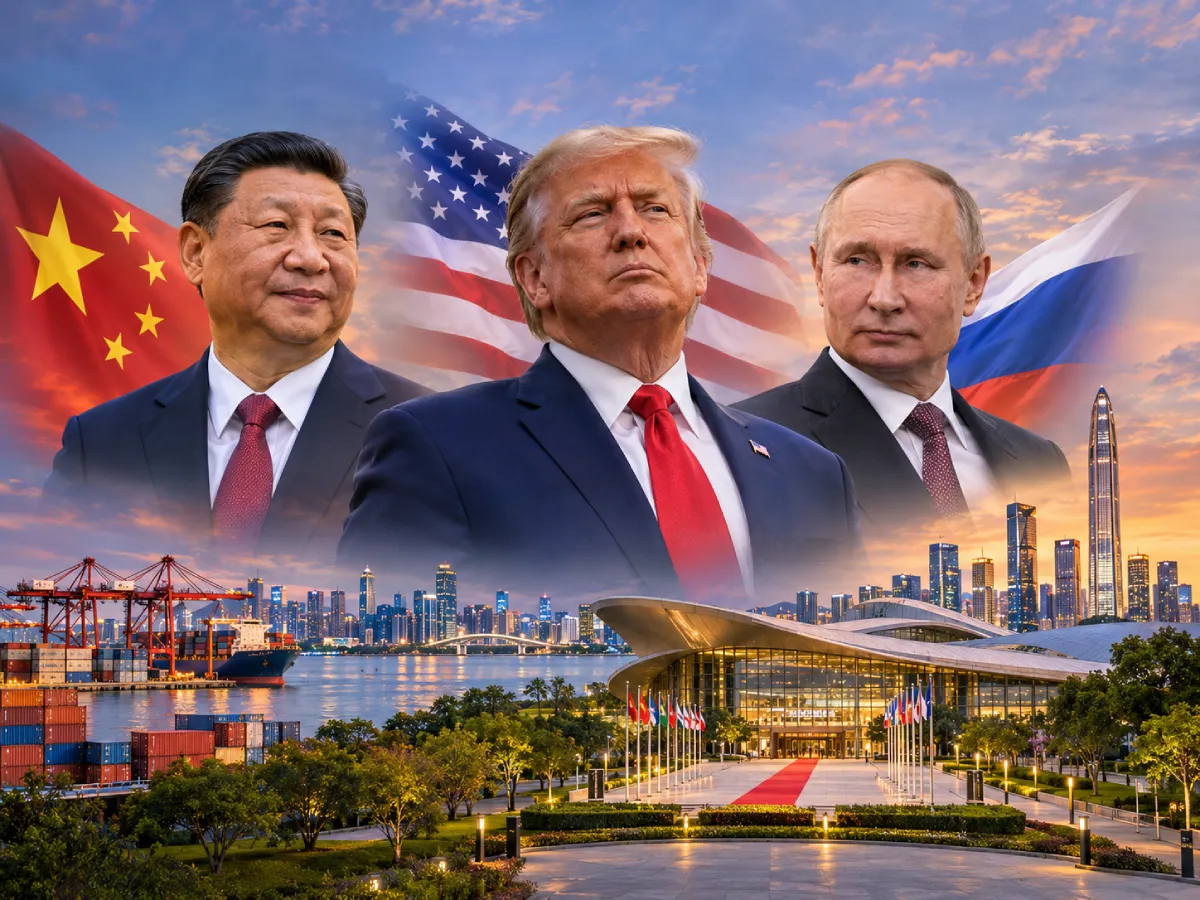

The APEC summit in Shenzhen, China, opened with sharp criticism of Western trade restrictions as Chinese President Xi Jinping defended open commerce and Russian President Vladimir Putin challenged the effectiveness of economic sanctions. Their remarks came Wednesday, November 18, 2026, as U.S. President Donald Trump arrived in China for high-stakes diplomatic meetings.
Xi welcomed Trump at the airport after the U.S. president traveled from the Philippines, where he had been meeting regional allies. The three leaders are expected to hold talks on Thursday, November 19, with trade, security and international conflicts among the potential subjects.
For readers following global developments on DealInNow.com, the summit could have important implications for U.S.-China trade relations, American technology companies and the war in Ukraine.
TL;DR
Xi Jinping criticized protectionism and called for greater international trade cooperation, while Vladimir Putin argued that Western sanctions had failed to isolate Russia. Donald Trump arrived in Shenzhen for meetings with both leaders on November 19. The talks could cover tariffs, advanced AI chips, Ukraine and nuclear security, but no major agreement has been announced.
Key Takeaways
- China defends open trade: Xi criticized protectionism and pledged to expand market access while preserving China’s industrial development strategy.
- Putin rejects Western sanctions: The Russian president argued that economic restrictions have not achieved their intended objectives.
- Trump arrives in Shenzhen: Xi personally welcomed the U.S. president ahead of Thursday’s planned three-way meeting.
- AI chips remain a flashpoint: New American restrictions on China’s access to advanced semiconductors have increased trade tensions.
- Major diplomatic issues remain unresolved: Ukraine, Iran, nuclear weapons and regional security could feature in the talks, although outcomes remain uncertain.
Xi Jinping Calls for Open Trade at the APEC Summit
Xi used his keynote address at the Asia-Pacific Economic Cooperation gathering to present China as a supporter of international commerce.
According to Reuters’ November 18 report, Xi called for a stronger multilateral trading system and warned against unilateral trade barriers.
He emphasized keeping global supply chains operating smoothly and strengthening economic partnerships throughout the Asia-Pacific region.
China also pledged to reduce tariffs, expand access to its domestic market and deepen international cooperation on emerging technologies.
The message comes as Beijing faces renewed pressure from Washington over trade practices and access to advanced American semiconductor technology.
However, China’s position is contested. U.S. and European officials have expressed concerns that Chinese industrial subsidies and manufacturing policies contribute to large trade imbalances and place foreign competitors at a disadvantage.
Beijing maintains that its economic strategy supports development and benefits global trade.
In his official APEC keynote address, Xi also promoted closer cooperation in artificial intelligence, digital commerce and industrial innovation.
Putin Criticizes Western Sanctions on Russia
Russian President Vladimir Putin delivered a separate message focused on economic restrictions imposed by Western countries.
Putin argued that sanctions, tariffs and export controls have not succeeded in stopping the growth of countries targeted by such measures.
According to AFP’s coverage of his remarks, he characterized Western efforts to isolate Russia as unsuccessful.
Russia has faced extensive sanctions from the United States and its allies since its full-scale invasion of Ukraine in February 2022.
Those restrictions target areas including finance, energy, technology and trade.
Putin’s claim that sanctions have failed is his government’s assessment, not an independently established conclusion.
Western governments argue that sanctions are intended to constrain Russia’s military capabilities, increase the economic cost of the war and discourage further aggression.
Canadian Prime Minister Mark Carney indicated that sanctions pressure would continue while the conflict remains unresolved.
Putin also met Xi in Shenzhen, where the two leaders reaffirmed their interest in expanding cooperation.
Trump Arrives in China for High-Stakes Talks
Trump’s arrival places the United States at the center of a potentially significant diplomatic gathering.
Xi greeted the American president at the airport, continuing a pattern of high-profile exchanges between the two leaders.
According to the Associated Press, Trump has indicated that he wants to discuss nuclear arms control and Russia’s war in Ukraine.
However, his administration has offered differing indications about the precise agenda.
Trump’s comments suggest a willingness to explore several major international issues, but that does not mean agreements have been reached.
The planned discussions are especially notable because Washington has sharply different relationships with Beijing and Moscow.
The United States and China maintain extensive economic ties despite strategic competition, while relations between Washington and Moscow remain complicated by Russia’s war in Ukraine and disputes over European security.
What the APEC Summit Means for U.S. Trade and AI
One of the most immediate concerns for American businesses is the future of U.S.-China trade restrictions.
Washington recently announced additional limits on China’s access to advanced AI chips, including technology supplied by U.S. companies such as Nvidia.
These restrictions are intended to address national security concerns involving advanced computing capabilities.
Beijing opposes the measures and has warned of retaliation.
Further disagreements could affect semiconductor manufacturers, technology supply chains and businesses operating in both markets.
For American companies, the consequences may include changes in export opportunities, compliance requirements and long-term investment planning.
Tariffs also remain contentious.
The Trump administration has defended its trade measures as tools for protecting American industries and addressing unfair trade practices.
China argues that additional barriers could disrupt commerce and weaken economic cooperation.
Neither position eliminates the competing economic and security concerns involved.
Why the China-Russia Relationship Matters
China and Russia have maintained close diplomatic and economic relations despite growing tensions between Moscow and Western governments.
Their partnership includes energy, trade and broader foreign-policy coordination.
At the Shenzhen summit, Xi and Putin reiterated support for a more multipolar international system.
That approach emphasizes reducing the dominance of any single country in global affairs.
For the United States and its allies, closer China-Russia cooperation raises questions about sanctions enforcement, technology access and international security.
Yet Beijing and Moscow also have distinct economic interests and relationships with other countries.
Their partnership should not be interpreted as evidence that they will automatically agree on every diplomatic or economic issue.
Could the Trump-Xi-Putin Meeting Change the Ukraine War?
Ukraine is among the most sensitive potential subjects of Thursday’s discussions.
Trump has suggested that negotiations involving Russia could create opportunities to move toward an end to the conflict.
However, no ceasefire or peace agreement has been announced in connection with the planned meeting.
European governments and Ukraine remain directly affected by any possible settlement.
Some governments have expressed concern that major powers could discuss security arrangements without adequately representing smaller countries’ interests.
Any lasting agreement would require addressing difficult questions involving territory, sovereignty, security guarantees and enforcement.
It would be premature to predict a breakthrough from the summit alone.
What Happens Next?
The APEC Economic Leaders’ Meeting is scheduled for November 18–19 in Shenzhen.
The gathering includes discussions on regional trade, connectivity, digital technology and economic cooperation.
The planned Thursday meeting involving Trump, Xi and Putin will draw particularly close attention.
Investors and businesses will be watching for announcements involving tariffs, semiconductor export restrictions, trade negotiations and international security.
Officials may also provide further details about future diplomatic meetings and working-level negotiations.
Final Thoughts
The speeches by Xi Jinping and Vladimir Putin highlight the competing visions shaping international economic policy.
China is presenting itself as a defender of open trade, while Russia is challenging the effectiveness of Western sanctions.
Trump arrives with his own priorities, including trade negotiations, national security and potential diplomatic initiatives involving major conflicts.
The central question is whether the leaders can move beyond competing statements and produce practical agreements.
For now, the summit represents an important diplomatic opportunity rather than a confirmed resolution to the disputes dividing Washington, Beijing and Moscow.
Verified Sources
1. Reuters — Xi and Putin Criticize Western Policies as Trump Arrives https://www.reuters.com/world/chinas-xi-calls-free-open-trade-apec-summit-2026-11-18/
2. AFP — Putin Criticizes Sanctions Ahead of Meeting https://origin-zh9p7m-www.afp.com/en/putin-slams-sanctions-ahead-summit-trump-xi