




A Scattered Spider hacker has been sentenced to six years in a U.S. federal prison for his involvement in a cybercrime conspiracy that stole more than $11.6 million in cryptocurrency. The case highlights how fraudulent text messages, stolen corporate credentials and SIM-swapping attacks can lead to devastating financial losses.
Tyler Robert Buchanan, a 24-year-old British national from Dundee, Scotland, received the sentence on November 17, 2026, in Santa Ana, California.
For readers following cryptocurrency and cybersecurity developments on DealInNow.com, the case offers an important reminder: even substantial cryptocurrency holdings can be exposed when criminals compromise the accounts and identities protecting them.
TL;DR
British hacker Tyler Robert Buchanan received a 72-month federal prison sentence for his role in a phishing and cryptocurrency theft conspiracy linked to Scattered Spider. The group targeted at least 12 companies and stole more than $11.6 million from U.S. victims. A court will consider restitution on December 11, 2026.
Key Takeaways
- Six-year sentence: Buchanan was sentenced by U.S. District Judge John W. Holcomb on November 17.
- $11.6 million stolen: The figure represents the wider conspiracy’s cryptocurrency thefts, not money personally attributed entirely to Buchanan.
- Corporate victims: At least 12 companies were targeted through fraudulent text messages and credential theft.
- SIM swapping: The attackers used compromised phone numbers and account information to bypass SMS-based authentication.
- Restitution pending: A hearing to determine Buchanan’s payment obligations is scheduled for December 11.
Scattered Spider Hacker Sentenced in California
According to the U.S. Department of Justice’s official sentencing announcement, Buchanan was sentenced to 72 months in prison after pleading guilty to conspiracy to commit wire fraud and aggravated identity theft.
He entered his guilty plea on April 17, 2026.
Buchanan had been in U.S. federal custody since April 2025. He was the fifth and final defendant sentenced in the case.
The criminal activity took place between September 2021 and April 2023.
Prosecutors said the conspirators targeted employees of telecommunications companies, technology businesses, entertainment companies, IT suppliers, cryptocurrency services and other organizations.
The stolen information was later used to access individual cryptocurrency accounts and wallets.
How Did the Hackers Steal $11.6 Million in Crypto?
The operation relied heavily on social engineering: manipulating people into revealing confidential information or granting access to systems.
Instead of attacking cryptocurrency blockchain networks directly, the criminals targeted accounts and the people who controlled them.
According to federal prosecutors, the group sent hundreds of fraudulent text messages that appeared to come from legitimate employers or technology-support providers.
Recipients were directed to counterfeit websites designed to resemble genuine corporate login portals.
Once employees entered their credentials, the attackers obtained information that could be used to access company systems.
The conspirators also collected sensitive information, including names, email addresses, telephone numbers and account credentials.
That information helped them identify potential cryptocurrency victims.
How SIM Swapping Helped Bypass Account Security
SIM swapping was another important part of the scheme.
This type of attack occurs when someone fraudulently transfers a victim’s phone number to a SIM card or device controlled by the attacker.
Once criminals control the number, they may be able to intercept security codes delivered through text messages.
According to the FBI’s guidance on social engineering, SIM swapping can undermine authentication systems that rely on a mobile phone number.
In Buchanan’s case, prosecutors said the conspirators used unauthorized account access and SIM swaps to compromise cryptocurrency wallets and accounts.
Authorities also discovered files containing victim information on a device at Buchanan’s residence in Scotland, including cryptocurrency recovery phrases and account login information.
The attacks illustrate how security weaknesses surrounding an account can lead to theft even when the underlying blockchain is operating normally.
What Is the Scattered Spider Hacking Group?
Scattered Spider is the name used by cybersecurity researchers for a loosely connected cybercriminal collective known for social engineering and corporate network intrusions.
Researchers also track related activity under names including Octo Tempest and UNC3944.
The group has been associated with attacks involving stolen employee credentials, impersonation, phishing and ransomware.
According to BleepingComputer’s November 18 report, Buchanan was a leading figure in the collective.
Scattered Spider has been linked to several high-profile corporate security incidents. However, those broader incidents should not automatically be attributed to Buchanan or to the specific cryptocurrency theft conspiracy for which he was sentenced.
The case also demonstrates how cybercriminal networks can operate across international borders while targeting individuals and companies in the United States.
What Happened to the Other Four Defendants?
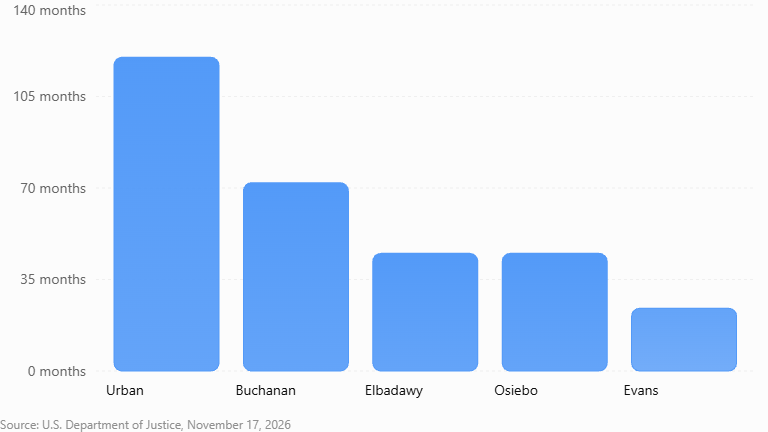
Buchanan was one of five defendants prosecuted in the case.
The Justice Department confirmed that all four co-defendants had already pleaded guilty and received prison sentences.
| Defendant | Federal prison sentence |
|---|---|
| Noah Michael Urban | 10 years |
| Tyler Robert Buchanan | 6 years |
| Ahmed Hossam Eldin Elbadawy | 45 months |
| Evans Onyeaka Osiebo | 45 months |
| Joel Martin Evans | 2 years |
The investigation involved the FBI and cooperation from law enforcement authorities in several countries, including the United Kingdom and Spain.
The December 11 restitution hearing will address how much Buchanan must repay victims. His final restitution obligation had not been determined at the time of sentencing.
How Can Cryptocurrency Investors Protect Their Accounts?
The case highlights the importance of securing cryptocurrency accounts against identity theft and unauthorized access.
The Federal Trade Commission’s SIM-swap guidance recommends stronger authentication methods and additional protections for mobile phone accounts.
Investors can reduce exposure by taking several precautions:
- Avoid unfamiliar login links. Open financial and exchange websites directly rather than through unexpected text messages.
- Use stronger authentication. Where available, choose passkeys, security keys or authenticator apps instead of relying exclusively on SMS codes.
- Protect mobile accounts. Ask your carrier about SIM-swap restrictions and account PINs.
- Secure recovery phrases. Never share wallet recovery words through messages, websites or unsolicited support conversations.
- Monitor account activity. Investigate unfamiliar login attempts or changes to account security settings.
No single measure eliminates every cyber threat, but layered security makes account takeovers more difficult.
Anyone who suspects an attack should contact the affected service providers promptly and consider reporting the incident through the FBI’s Internet Crime Complaint Center.
Why This Crypto Theft Sentence Matters
The prosecution demonstrates that large cryptocurrency thefts can originate from relatively familiar forms of fraud.
Employees were tricked into surrendering credentials, sensitive information was collected, and victims’ account protections were bypassed.
The case also shows the importance of international law enforcement cooperation when cybercriminals and their victims are located in different countries.
For businesses, the lesson extends beyond protecting digital assets. Employee authentication, customer-support procedures and mobile account security can all become points of exposure.
For individual cryptocurrency holders, controlling access to accounts and wallet recovery information remains essential.
Final Thoughts
Tyler Robert Buchanan’s six-year prison sentence closes the criminal sentencing stage of a conspiracy that caused more than $11.6 million in cryptocurrency losses.
All five defendants have now been sentenced, although the restitution process for Buchanan remains unfinished.
The broader lesson is that cryptocurrency theft does not always require exploiting a blockchain. Criminals can cause enormous damage by manipulating employees, stealing passwords and taking control of phone numbers.
As digital assets become more widely used, stronger account security and awareness of social engineering remain important safeguards.
Disclaimer: This article is for informational and cybersecurity education purposes only. It does not constitute legal or financial advice.
Verified Sources
1. U.S. Department of Justice
https://www.justice.gov/usao-cdca/pr/british-national-sentenced-6-years-federal-prison-hacking-companies-and-stealing-least
2. Bleeping Computer
https://www.bleepingcomputer.com/news/security/british-scattered-spider-hacker-sentenced-to-6-years-in-prison/
3. Federal Trade Commission (FTC)
https://consumer.ftc.gov/consumer-alerts/2019/10/sim-swap-scams-how-protect-yourself