


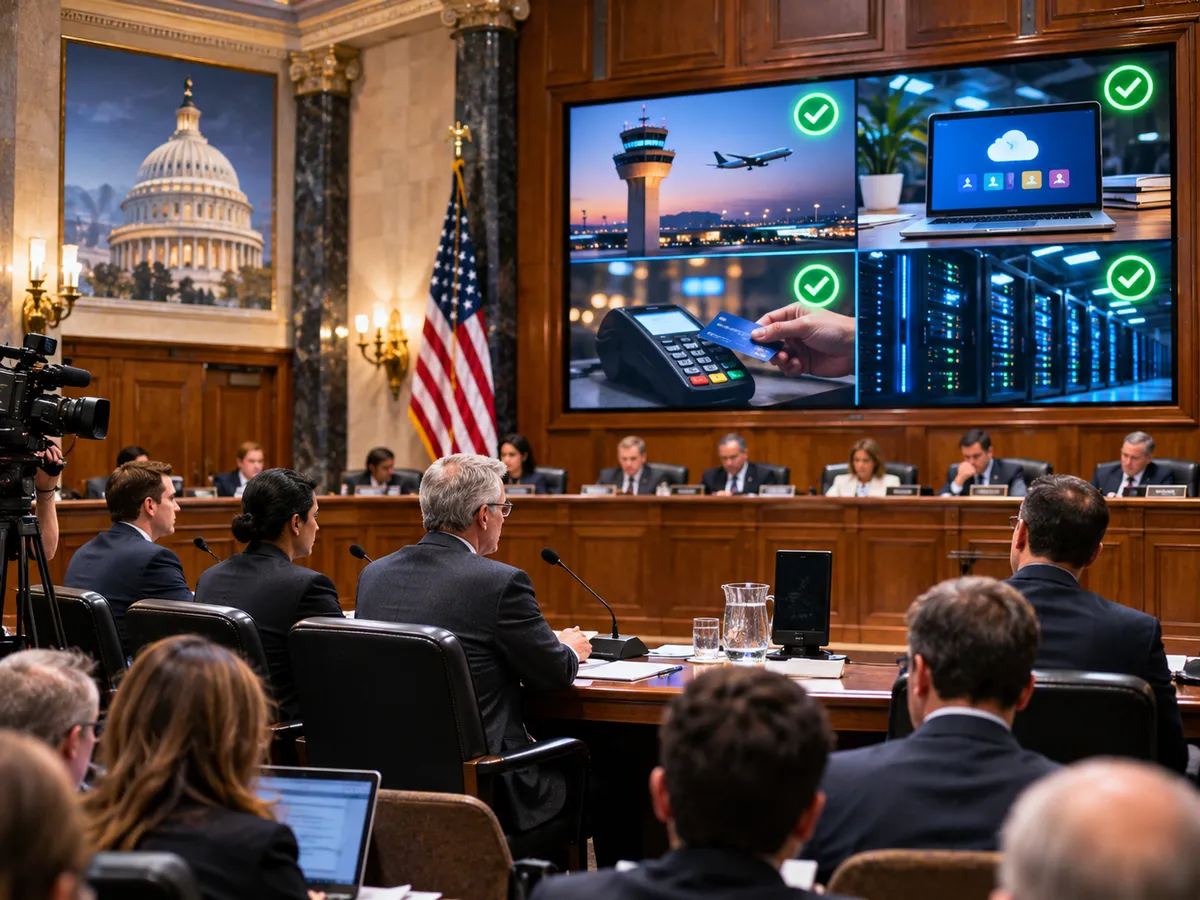

U.S. technology outages have disrupted airports, banks, workplace software and government communications within days of one another. The unusual succession of failures has prompted questions about whether someone is deliberately targeting the systems Americans rely on. Federal security officials say the evidence so far points in a different direction.
During a congressional hearing on Wednesday, November 18, senior officials from the Department of Homeland Security, FBI and U.S. intelligence community said they had found no evidence linking the incidents to a coordinated cyberattack or foreign interference.
The reassurance comes after a difficult week for travelers, banking customers, businesses and federal agencies.
For readers following the latest cybersecurity and infrastructure developments on DealInNow.com, the central issue is no longer simply whether the disruptions were malicious. It is also why legitimate maintenance and technical changes can cause such extensive problems.
TL;DR
U.S. intelligence and security officials told Congress that recent disruptions affecting Microsoft, the FAA, JPMorgan Chase and government systems do not appear to be connected or caused by cybercriminals. The incidents involved different technical problems, although some investigations continue. Officials and cybersecurity experts are increasingly focusing on aging infrastructure, system upgrades and the risks of rushed software changes.
Key Takeaways
- No coordinated attack identified: Federal officials reported no evidence connecting the recent disruptions to hackers or foreign governments.
- Congress demands answers: Senior DHS, FBI and intelligence officials addressed the outages during a November 18 House hearing.
- Multiple sectors affected: Aviation, banking, cloud computing, airlines and classified government communications experienced separate problems.
- Aging systems are under scrutiny: Maintenance, software changes and infrastructure upgrades have emerged as important explanations.
- Investigations continue: The absence of evidence of hacking does not establish that every technical cause has been fully determined.
What U.S. Officials Told Congress About the Outages
The House Homeland Security Committee hearing on November 18 brought three senior national security officials before lawmakers: Homeland Security Secretary Markwayne Mullin, Director of National Intelligence Jay Clayton and FBI Deputy Director Christopher Raia.
The hearing was scheduled to examine threats facing the United States, but the recent technology failures became an important part of the discussion.
Clayton said government agencies had examined the disruptions alongside private-sector cybersecurity experts and found no signs of a coordinated or state-sponsored attack.
Mullin also indicated that investigators had not identified evidence connecting the incidents.
According to CBS News’ coverage of the congressional hearing, Raia confirmed that FBI cyber specialists had been involved in the review and would continue working with companies as a precaution.
The officials’ assessments were consistent with earlier statements from Secretary of State Marco Rubio, who said the incidents appeared to have separate causes.
These findings offer an important distinction between a widespread technical failure and an intentional cyberattack.
Which Technology Outages Affected Major U.S. Services?
The recent failures affected several unrelated organizations, often with different underlying technologies.
| Date | Organization | Reported disruption |
|---|---|---|
| November 12 | Microsoft | Outlook, Teams and other Microsoft 365 services experienced a major outage |
| November 13 | Federal Aviation Administration | Telecommunications instability triggered a nationwide ground stop |
| November 16 | JPMorgan Chase | A software problem disrupted transactions and affected payments involving other banks |
| November 16 | United Airlines | An internal technology problem delayed flight departures |
| November 17 | National Security Agency | A classified internal communications network experienced problems during maintenance |
| November 17 | Apple | An internal update disrupted several services, including iCloud-related functions and the App Store |
The timing made the problems appear connected, but federal officials have not identified a shared malicious cause.
The incidents also differed in their consequences. Some affected consumer applications, while others interrupted nationally important transportation and government systems.
Why the FAA Shutdown Raised National Security Questions
The most visible disruption occurred on Friday, November 13, when the Federal Aviation Administration ordered a nationwide ground stop.
The restrictions temporarily prevented most commercial flights from departing while technicians investigated unreliable communications and radar information.
Officials identified a telecommunications problem associated with network modernization work. Investigators examined a router connected to the affected infrastructure.
The incident caused extensive airline cancellations and delays even after the ground stop ended.
According to Reuters’ reporting on the aviation disruption, federal officials said there was no evidence that the shutdown resulted from an external cyberattack.
However, the exact technical sequence behind the failure remained under investigation.
The distinction matters because the FAA must prioritize aviation safety whenever systems used by air traffic controllers become unreliable.
The episode also demonstrated how a failure affecting specialized communications equipment can disrupt travel across an entire country.
Microsoft and Chase Reveal Different Technical Weaknesses
Microsoft’s problems began on November 12 and affected Outlook, Teams and other Microsoft 365 services.
Businesses, government agencies and individual users experienced communication difficulties as the company worked to restore service.
Microsoft said the outage was not associated with malicious activity.
Readers can find background on the original service interruptions in DealInNow’s Microsoft Outlook outage coverage.
JPMorgan Chase faced a separate problem on November 16.
The bank attributed transaction disruptions to an internal software bug involving its systems.
Some customers at other financial institutions encountered payment difficulties when transactions involved Chase.
The bank said the incident was not cyber-related.
These failures illustrate how an internal technical issue can spread beyond the organization where it originates, particularly when other services depend on its infrastructure.
Why the NSA Network Outage Drew Special Attention
The disruption involving the National Security Agency generated additional concern because it affected a government organization responsible for signals intelligence and cybersecurity.
On November 17, a classified internal communications network experienced a temporary interruption.
According to the Associated Press, the NSA attributed the problem to routine maintenance.
The agency said its mission-critical capabilities remained operational despite the disruption.
That detail was important because problems involving classified communication systems can raise questions about national security even when there is no evidence of hostile interference.
During Wednesday’s hearing, Democratic Representative Dan Goldman pressed Clayton to explain the technical basis for his conclusions about the incident.
Clayton maintained that investigators had found no evidence of external interference, although his answers did not provide a complete public explanation of the underlying technical failure.
The exchange highlighted the difference between ruling out available signs of an attack and establishing a final root cause.
Could Software Updates Be Behind the Latest Technology Failures?
One explanation receiving increased attention is the difficulty of maintaining older digital infrastructure while introducing new software and networking technology.
Modern systems depend on many components working together: servers, authentication services, databases, communication equipment and third-party platforms.
Upgrading one part of a system can sometimes create unexpected problems elsewhere.
For example, a network change may increase traffic to equipment that cannot handle the additional demand.
A software update intended to address a security vulnerability may also interact with older applications in unexpected ways.
Cybersecurity experts have warned that the growing number of discovered vulnerabilities is increasing pressure on organizations to deploy security updates quickly.
According to a Reuters analysis published November 18, AI-assisted tools are accelerating the discovery of software vulnerabilities, leading organizations to patch their systems more frequently.
That can improve security, but poorly tested or complicated changes may temporarily reduce reliability.
This does not establish that AI caused the recent outages. The technology is one factor influencing the speed and scale of software maintenance.
Does No Evidence of Hacking Mean the Systems Are Safe?
Not necessarily.
A finding that an outage was not caused by malicious activity does not mean the affected infrastructure has no security vulnerabilities.
Technical reliability and cybersecurity are closely related, but they are not identical.
A system can fail because of defective equipment without an attacker being involved.
Likewise, a service can recover from an outage while still requiring improvements to monitoring, backup systems and maintenance procedures.
Government officials have emphasized the need to modernize aging infrastructure.
But upgrading critical technology requires careful planning because essential services cannot always be taken offline for extended periods.
For companies and federal agencies, the challenge is balancing rapid security improvements with dependable everyday operations.
What These Outages Mean for American Consumers and Businesses
The consequences of technical failures are often most visible in ordinary activities.
Travelers may miss flights or connecting services. Banking customers may be unable to complete time-sensitive transactions. Businesses may lose access to important communication tools.
Consumers can reduce some of the inconvenience by maintaining alternative payment methods, monitoring official service alerts and keeping essential contact information available.
Businesses should also consider backup communications, documented recovery procedures and regular checks of technology dependencies.
These measures cannot prevent every failure, but they can reduce disruption when a major provider becomes temporarily unavailable.
Cybersecurity precautions remain important as well. Criminals can exploit outage-related confusion by sending fake support messages or fraudulent account verification requests.
Users should verify service notices through official websites and avoid unexpected links requesting passwords or payment information.
What Investigators Still Need to Explain
The federal government has offered a consistent assessment that the recent disruptions were not part of a coordinated cyberattack.
However, the individual technical investigations have not all produced complete public findings.
For the FAA, questions remain about how network equipment and maintenance procedures contributed to the nationwide shutdown.
For organizations operating complex digital services, attention is shifting toward change management, infrastructure resilience and the ability to recover without creating additional failures.
Lawmakers may continue requesting details about how agencies identify risks, coordinate with private companies and communicate during large disruptions.
Greater technical transparency could help explain what happened and what steps are being taken to prevent similar incidents.
A Week of Failures Leaves a Broader Reliability Question
The latest congressional testimony reduces the basis for claims that the United States experienced a coordinated wave of cyberattacks.
But it does not erase the disruption Americans experienced.
The outages revealed how heavily daily life depends on digital services that are increasingly interconnected and difficult to maintain.
For government agencies and technology companies, the immediate responsibility is to complete investigations and address weaknesses found along the way.
The longer-term challenge is building infrastructure that can withstand routine updates, equipment failures and unexpected technical changes without bringing essential services to a halt.