


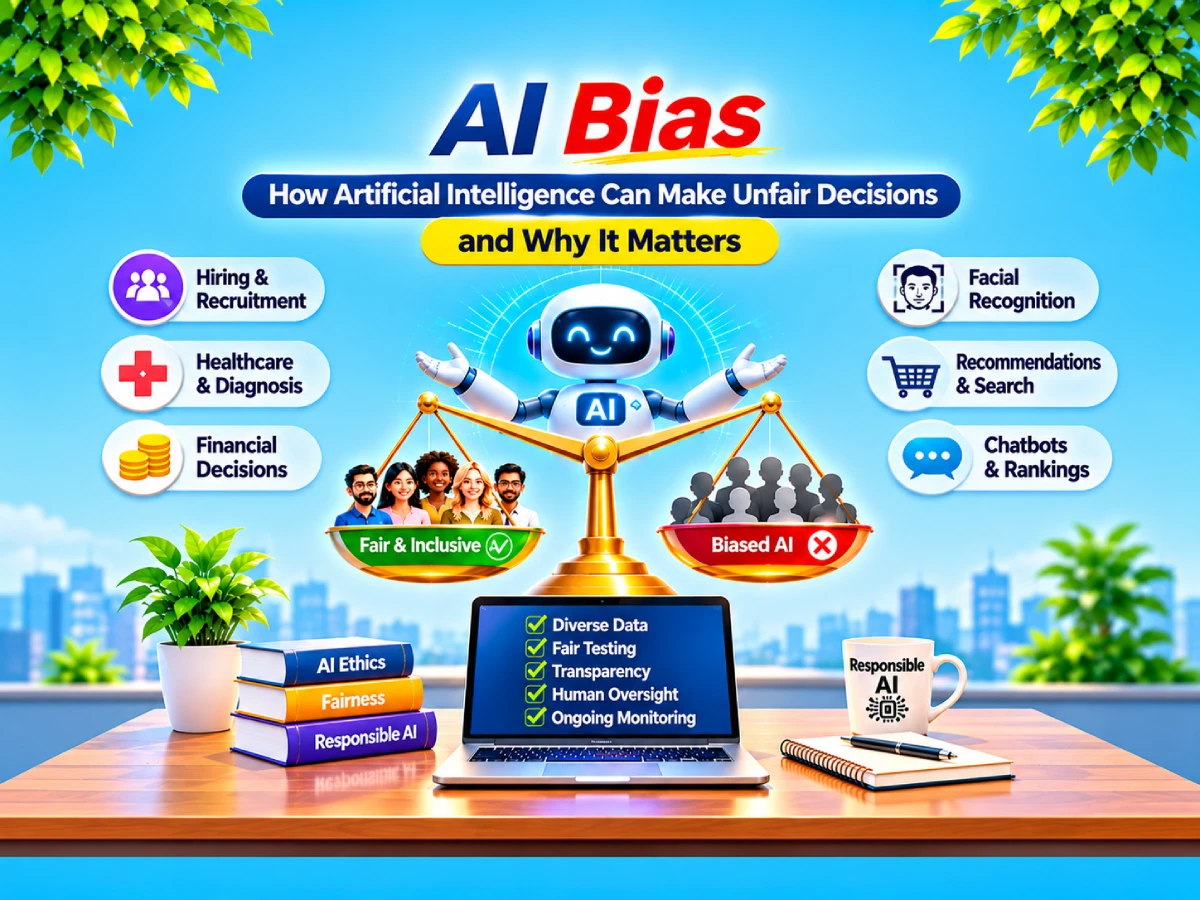

AI Bias: How Artificial Intelligence Can Make Unfair Decisions and Why It Matters
Artificial intelligence is becoming part of everyday life. From search engines and chatbots to recruitment platforms, banking services and healthcare tools, AI systems are increasingly influencing the information people receive and the decisions organizations make.
But AI is not always neutral. Despite being powered by algorithms and data, artificial intelligence can produce unfair, inaccurate or discriminatory outcomes. This problem is commonly known as AI bias.
AI bias can affect how people are evaluated, which opportunities they receive, what information they see and how businesses make decisions. As organizations adopt AI at a faster pace, understanding and managing bias has become an important part of responsible technology development.
In this article, we explain what AI bias means, why it happens, real-world examples, its impact on businesses and individuals, and the steps that can help reduce it.
What Is AI Bias?
AI bias occurs when an artificial intelligence system produces results that systematically disadvantage certain individuals or groups, or consistently favor others, in ways that are unfair or inappropriate for the intended purpose.
AI systems learn patterns from training data. If that data contains historical inequalities, incomplete information, stereotypes or underrepresented groups, the system may reproduce those patterns in its outputs.
For example, an AI recruitment tool trained mainly on historical hiring data from one demographic group may favor candidates with similar backgrounds. Even if the system does not explicitly consider gender, age or other personal characteristics, patterns in the data may still influence its recommendations.
AI bias does not always happen because someone intentionally designed a discriminatory system. It can emerge from data collection, model development, testing, deployment or the way people use AI-generated results.
The US National Institute of Standards and Technology (NIST) explains that harmful bias can exist throughout AI processes and create negative impacts even when there is no intention to discriminate.
Why Does AI Bias Happen?
There is no single reason behind AI bias. It can develop at different stages of an AI system’s lifecycle.
1. Biased or Unrepresentative Training Data
AI models depend heavily on the information used to train them. If the training dataset does not adequately represent different populations, languages, locations or backgrounds, the system may perform better for some groups than others.
For example, a facial recognition system trained predominantly on images of certain skin tones may produce less accurate results for people whose skin tones are underrepresented.
The problem is not necessarily the algorithm itself. The quality, diversity and representation of the training data also matter.
2. Historical Inequality in Data
AI systems can learn from historical records that reflect existing social and economic inequalities.
Consider a recruitment model trained using past hiring decisions. If an organization historically selected candidates from a limited range of backgrounds, the model may learn to favor similar profiles.
As a result, the system could continue an unfair pattern rather than identify the most suitable candidates based on relevant skills and qualifications.
3. Human Assumptions and Design Decisions
People make important decisions when building AI systems, including which data to collect, which outcomes to measure and how success should be defined.
If developers or organizations make assumptions that do not reflect the needs of all users, those assumptions can influence the final system.
For instance, a product recommendation system designed around the shopping habits of one customer group may not work equally well for people with different preferences or purchasing patterns.
4. Language and Cultural Representation
AI systems may not understand every language, regional expression or cultural context equally well.
Large language models are trained on enormous collections of text, but the amount and quality of available information vary across languages and communities.
This can lead to differences in response quality, inaccurate cultural assumptions or stereotypical descriptions of certain regions and populations.
5. Incomplete Testing and Monitoring
An AI system may perform well during initial testing but produce unexpected results when used in real-world situations.
If developers test a model using only a limited set of users or scenarios, they may overlook problems affecting other groups.
Bias can also appear after deployment when user behavior, data patterns or the system’s operating environment changes.
Real-World Examples of AI Bias
AI bias is not limited to academic research. It can affect everyday applications and decisions across several industries.
1. AI Recruitment and Hiring
Companies increasingly use automated tools to screen resumes, rank candidates and identify potential employees.
However, a recruitment model trained on historical hiring records may learn patterns that favor certain educational backgrounds, career paths or demographic groups.
This can disadvantage qualified applicants whose profiles differ from those represented in the training data.
Businesses should regularly evaluate hiring tools to ensure that recommendations are based on relevant qualifications and job requirements.
2. Healthcare and Medical AI
AI tools are being developed to support medical image analysis, risk prediction and clinical decision-making.
However, if training datasets do not represent different patient populations adequately, the system may not perform consistently across all groups.
This can create risks when healthcare professionals rely on automated recommendations without considering their limitations.
Medical AI should be evaluated using appropriate clinical data, tested across relevant populations and used with qualified professional oversight.
3. Facial Recognition Technology
Facial recognition systems can be affected by differences in training data, image quality, lighting and demographic representation.
If a system performs less accurately for certain groups, it may create problems in identity verification, security applications and other sensitive environments.
This is why accuracy should not be measured only through an overall performance score. Testing should also examine how the system performs across relevant demographic groups and real-world conditions.
4. Chatbots and AI-Generated Rankings
Generative AI tools can produce confident answers that reflect patterns, assumptions and limitations in their training data.
For example, when ChatGPT was asked to rank US states, the resulting rankings raised questions about subjective judgments, regional stereotypes and how AI systems represent different places.
You can read more about this example in our related article: ChatGPT State Rankings: What They Reveal About AI Bias.
This illustrates why AI-generated rankings and opinions should not automatically be treated as objective facts. Users should examine the criteria behind a ranking and verify claims before relying on them.
5. Financial Services and Credit Decisions
Financial institutions may use AI and machine learning models to support credit assessments, fraud detection and risk analysis.
If a model relies on incomplete or historically biased information, its predictions may produce unfair outcomes for some applicants.
Organizations should examine the data and variables used in these systems, test for unequal outcomes and provide appropriate review processes when automated decisions affect people’s access to financial services.
6. Search and Recommendation Systems
Search engines, social platforms and online shopping services use algorithms to decide which content, products or recommendations users see.
These systems may reinforce existing preferences, repeat misleading patterns or provide different experiences depending on the available data and optimization goals.
Although personalization can be useful, it is important to evaluate whether recommendation systems are producing harmful or unfair results.
How Does AI Bias Affect Businesses and Consumers?
AI bias can create consequences that go beyond inaccurate predictions. It can affect individuals, organizations and public trust in technology.
For consumers:
- Unfair treatment in automated decisions.
- Limited access to certain services or opportunities.
- Inaccurate recommendations or information.
- Reduced confidence in AI-powered platforms.
- Difficulty understanding or challenging automated outcomes.
For businesses:
- Reputational damage and loss of customer trust.
- Potential legal and regulatory risks.
- Poor decision-making based on unreliable outputs.
- Reduced effectiveness of AI-powered products.
- Additional costs associated with investigating and correcting problems.
For businesses, responsible AI is not simply a technical requirement. It is also important for customer confidence, operational quality and long-term adoption.
How Can Companies Reduce AI Bias?
AI bias cannot always be eliminated completely, but organizations can take practical steps to identify, measure and reduce unfair outcomes.
1. Use Diverse and Representative Data
Training datasets should reflect the people, environments and situations in which an AI system will be used.
Organizations should identify missing groups, examine data quality and avoid relying on datasets that represent only a narrow population.
2. Conduct Regular Fairness Audits
AI models should be tested for differences in performance across relevant groups.
For example, a company using an AI recruitment system should examine whether qualified applicants receive significantly different recommendations based on characteristics unrelated to job performance.
Testing should take place before deployment and continue throughout the system’s operation.
3. Improve Transparency
Businesses should understand what their AI systems are designed to do, what information they use and where their limitations exist.
Users should receive appropriate information when AI plays an important role in a decision affecting them.
Clear documentation can also help organizations investigate unexpected outcomes.
4. Maintain Human Oversight
AI should not automatically replace human judgment in sensitive decisions.
In areas such as healthcare, recruitment, financial services and public administration, qualified people should review important decisions and be able to question or override automated recommendations where appropriate.
5. Monitor AI Systems After Deployment
AI systems need ongoing evaluation. Changes in user behavior, datasets and operating conditions can affect performance over time.
Organizations should monitor results, collect feedback, investigate complaints and update systems when problems are identified.
6. Involve Different Perspectives
Developers should work with people from different professional, cultural and demographic backgrounds when designing and evaluating AI systems.
Input from affected communities can help identify assumptions and problems that technical testing alone may overlook.
AI Bias and Responsible AI Regulations
Governments and standards organizations are increasingly addressing the risks associated with artificial intelligence.
One important resource is the NIST AI Risk Management Framework, which provides guidance for organizations seeking to manage risks and improve the trustworthiness of AI systems.
NIST’s framework highlights characteristics such as reliability, safety, accountability, transparency, privacy and fairness. It also encourages organizations to manage AI risks throughout the system lifecycle.
Another important reference is the NIST publication on identifying and managing bias in artificial intelligence. It examines how bias can arise through technical processes as well as broader social and organizational factors.
In the European Union, the EU AI Act introduces a risk-based regulatory approach. Certain AI applications face stricter requirements, including obligations related to risk management, data quality, documentation and human oversight.
These frameworks demonstrate the growing importance of evaluating AI systems not only for performance but also for their potential impact on individuals and society.
Can Artificial Intelligence Ever Be Completely Unbiased?
Achieving completely unbiased AI is difficult because AI systems are developed using data, human decisions and assumptions about the world.
Even when a dataset is carefully selected, different groups may experience the same system differently depending on their circumstances and the way the technology is used.
There is also no single definition of fairness that applies to every situation. A method that improves fairness in one application may create trade-offs in another.
The more practical goal is to identify harmful bias, understand its causes, reduce unfair outcomes and maintain accountability.
Organizations should treat fairness as an ongoing responsibility rather than a one-time technical adjustment.
What Should Users Do When They Notice AI Bias?
Users should avoid assuming that every AI-generated answer or recommendation is accurate or neutral.
A few practical habits can help:
- Verify important information using reliable sources.
- Check the evidence behind AI-generated rankings and comparisons.
- Be cautious when AI makes broad claims about communities or locations.
- Question automated decisions that appear inaccurate or unfair.
- Use available feedback or appeal channels to report problems.
- Avoid relying on AI alone for important medical, financial or legal decisions.
AI tools can be useful for research, productivity and decision support, but their outputs should be evaluated in context.
Conclusion: Building Fairer and More Responsible AI
Artificial intelligence has the potential to improve productivity, support innovation and make information more accessible. However, its benefits depend partly on how responsibly these systems are designed, trained and used.
AI bias is a serious challenge because unfair patterns can become part of automated systems and influence decisions at scale. Biased training data, historical inequalities, limited representation and inadequate testing can all contribute to the problem.
Businesses, developers and policymakers need to work together to improve data quality, strengthen fairness testing, maintain human oversight and monitor AI systems after deployment.
The goal should not simply be to build more powerful AI. It should be to build AI that is reliable, transparent, accountable and fair to the people who use it.
Disclaimer: This article is for general informational and educational purposes only. It should not be considered legal, medical, financial or professional advice.