


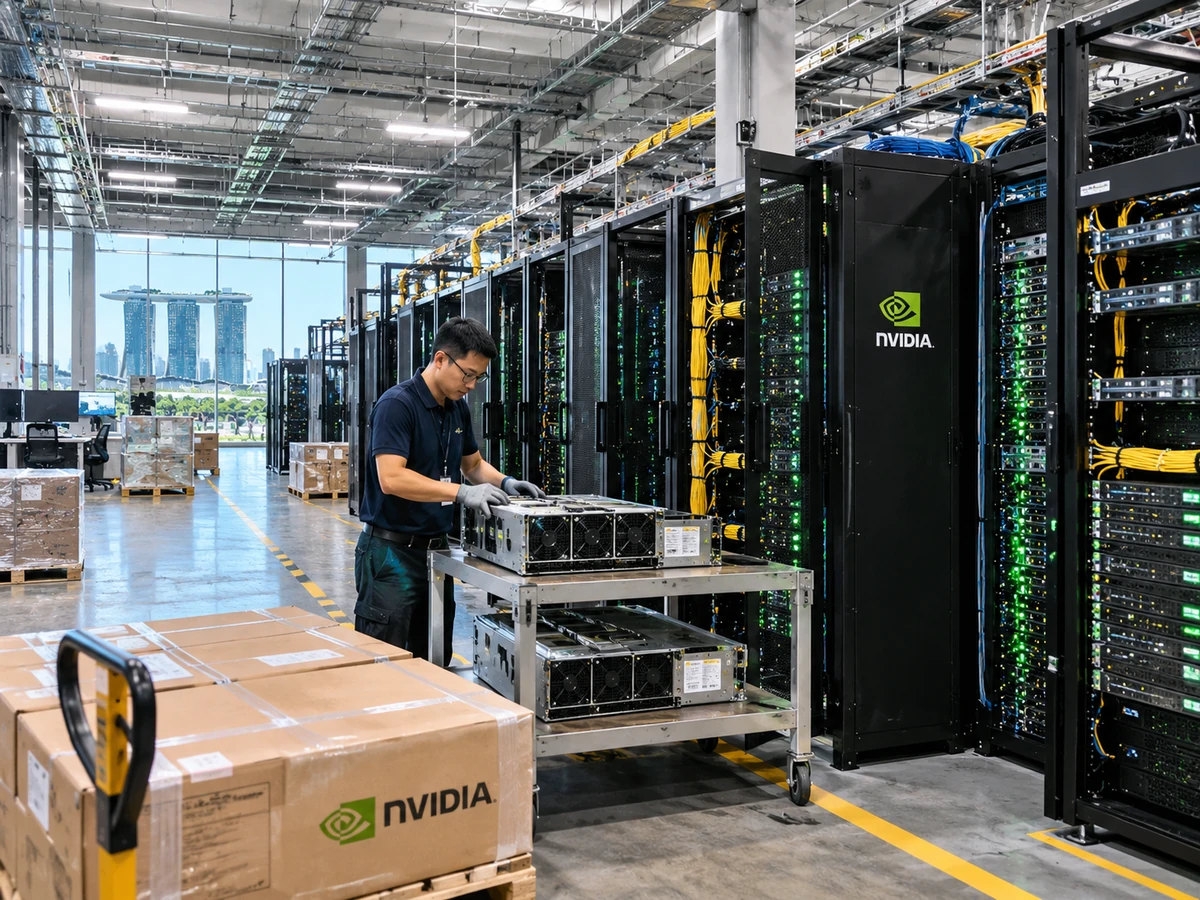

WASHINGTON, November 27, 2026 — A growing controversy involving Nvidia, its chief executive Jensen Huang and a Singapore-based cloud computing company has exposed a major weakness in Washington’s efforts to limit China’s access to powerful American artificial intelligence chips.
The Nvidia chip export loophole allowed some Chinese companies to rent advanced computing power from overseas data centers without bringing the restricted processors into China. That arrangement has become the focus of new U.S. export restrictions, regulatory investigations and concerns about the global AI supply chain.
On November 19, the U.S. Commerce Department’s new rules took effect, targeting both certain overseas chip shipments and remote access to powerful computing infrastructure. Days later, Nvidia reportedly instructed manufacturing partners to pause AI-server deliveries to four Southeast Asian countries.
For readers following AI, technology and international business developments at DealInNow, the controversy illustrates a challenge that goes far beyond one company: controlling access to advanced computing technology is much harder when the computing itself can be rented through the internet.
TL;DR
The Nvidia controversy has exposed how Chinese companies could access restricted American AI computing power through overseas data centers. The United States introduced new export-control rules on November 19, blacklisted Megaspeed-related companies on November 23, and Nvidia reportedly paused some Southeast Asian server shipments. The new restrictions target both physical chip transfers and certain remote computing arrangements.
Key Takeaways
- Chinese AI companies have used overseas data centers to rent computing power from advanced Nvidia chips without physically importing those chips into China.
- U.S. officials introduced new export rules effective November 19, 2026, to address remote access and possible chip diversion.
- Singapore-based Megaspeed and six related entities were added to a U.S. trade blacklist on November 23.
- Nvidia reportedly paused AI-server shipments to Malaysia, Singapore, Thailand and Indonesia following the regulatory changes.
- The investigations do not establish that Nvidia or every overseas cloud provider knowingly participated in illegal chip smuggling.
How the Nvidia Chip Export Loophole Worked
For years, the United States has restricted exports of some of the world’s most powerful AI processors to China.
The restrictions are designed to limit Beijing’s access to computing technology that could support advanced military systems, intelligence applications and other sensitive capabilities.
But export controls traditionally focus heavily on where physical products are shipped and who receives them.
Cloud computing creates a different situation.
A company in China may not need to purchase and import an advanced Nvidia processor. Instead, it can potentially pay a cloud provider in another country to run AI workloads using chips located in that provider’s data center.
The physical chips stay outside China, but the customer receives access to their computing power remotely.
That distinction became increasingly important as Chinese AI developers sought alternatives to restricted hardware purchases.
Why Southeast Asia Became a Major AI Computing Hub
Singapore, Malaysia, Indonesia and Thailand have attracted substantial investment in data centers.
Their proximity to China, growing digital infrastructure and access to international markets have made them attractive locations for computing operations.
According to Reuters, Chinese technology companies have increasingly explored overseas computing arrangements to access advanced Nvidia-powered systems.
Some cloud providers purchase servers themselves and rent computing capacity to customers.
Others operate through financing, leasing and infrastructure partnerships involving companies in several countries.
Such commercial arrangements are not automatically illegal. Their legality depends on the applicable export rules, the customers involved, the technology and the intended use.
However, they have also created opportunities for companies seeking to evade restrictions.
Why Megaspeed Became Central to Nvidia’s Controversy
Megaspeed International, a Singapore-based cloud computing provider, emerged as a central company in the controversy surrounding Nvidia.
Authorities in Singapore and the United States have been examining whether advanced AI servers were improperly diverted to unauthorized destinations.
Megaspeed previously purchased Nvidia-powered equipment and offered computing services to customers.
The company also became the subject of greater scrutiny following reports about a relationship between Nvidia CEO Jensen Huang and Alice Huang, a former Megaspeed executive.
The personal controversy brought renewed attention to the company’s business relationships, oversight and compliance with U.S. export restrictions.
But the allegations require careful distinction.
Singapore’s government said investigators found insufficient evidence to prosecute Alice Huang over suspected inaccurate declarations related to Megaspeed.
The authorities nevertheless issued a warning and barred her from reentering Singapore. Investigations involving the company and other individuals have continued.
There has been no publicly established finding that Alice Huang committed espionage.
Similarly, the existence of a business relationship between Nvidia and Megaspeed does not by itself demonstrate that Nvidia knowingly facilitated unlawful chip exports.
U.S. Blacklists Seven Companies
On November 23, the U.S. Commerce Department added Megaspeed International and six related companies to the Entity List.
The additions, formally published in the Federal Register on November 25, covered entities in Singapore, Malaysia and Thailand.
The government cited concerns about their potential involvement in diverting advanced computing equipment to unauthorized users or purposes.
The listings generally require licenses for exports and other covered transactions involving U.S.-regulated items, with applications subject to a presumption of denial.
This substantially restricts the companies’ ability to obtain covered American technology.
An Entity List designation is a regulatory enforcement measure, however, and should not be described as proof of a criminal conviction.
Washington Moves to Close the Remote-Access Loophole
The most important policy development came on November 16, when the Commerce Department’s Bureau of Industry and Security announced new restrictions on overseas access to advanced American chips.
The rule took effect on November 19.
It addresses certain situations in which companies headquartered in China or other restricted destinations obtain large amounts of computing power through data centers elsewhere in the world.
The regulations also extend licensing requirements for covered advanced semiconductor exports to five additional countries:
- Singapore
- Malaysia
- Indonesia
- Thailand
- Brazil
The new framework does not impose a blanket prohibition on every shipment to those countries.
Licenses may be considered individually, and some qualifying transactions involving U.S.-headquartered companies are exempt from the new country-specific licensing requirements if reporting conditions are met.
The regulations also distinguish covered high-volume computing arrangements from certain commercial activities that do not present the same identified security concerns.
The goal is to bring more overseas transactions under U.S. review before sensitive computing equipment can reach unauthorized users.
How the New Rules Change the Situation
| Issue | Before the new rules | After November 19 |
|---|---|---|
| Remote computing | Some arrangements operated outside specific restrictions | Certain high-volume access arrangements face licensing requirements |
| Southeast Asian chip shipments | Several destinations did not face the newly added country-specific controls | Covered shipments to four Southeast Asian countries and Brazil face additional licensing |
| Customer checks | Existing end-user and diversion rules applied | Additional due diligence on ownership, control and end use |
| Overseas data centers | Could provide computing services under applicable earlier rules | More arrangements involving restricted customers are subject to U.S. review |
| Enforcement | Authorities investigated suspected diversion | New restrictions add oversight and potential enforcement tools |
The exact requirements depend on technical thresholds, customer relationships and the applicable provisions of the Export Administration Regulations.
Nvidia Reportedly Pauses Shipments Across Southeast Asia
The regulatory changes quickly began affecting commercial supply arrangements.
On November 26, the Financial Times reported that Nvidia had told manufacturing partners, including Dell and Supermicro, to stop shipping certain servers containing its AI processors to Malaysia, Singapore, Thailand and Indonesia.
Reuters subsequently reported the development, citing the Financial Times.
The duration of the reported pause was unclear.
Nvidia and its partners were reportedly reviewing compliance requirements under the newly effective restrictions.
On November 27, Singapore Deputy Prime Minister Gan Kim Yong said his government had not independently confirmed the reported shipment halt.
Singapore was consulting businesses to assess the impact of the new U.S. regulations.
This distinction matters: a reported company-level pause is not the same as a permanent prohibition imposed on all AI-server sales to Southeast Asia.
Why the Changes Matter for American Technology Companies
Nvidia’s processors are central to the global market for advanced AI computing.
Major cloud providers, technology companies and research organizations rely on powerful GPUs to train and operate AI models.
The new restrictions could increase compliance costs and delay legitimate projects as suppliers examine where equipment is going and who will ultimately use it.
Server manufacturers and cloud providers may face additional documentation, licensing and customer-verification requirements.
That could affect companies headquartered in the United States as well as international customers operating in Southeast Asia.
At the same time, U.S. officials argue that tighter controls are necessary to prevent restricted technology from reaching unauthorized users.
For Nvidia, the challenge is balancing commercial opportunities with increasingly complicated export regulations.
Does the New Rule End China’s Access to Nvidia Chips?
Not entirely.
The United States continues to allow certain semiconductor exports to approved Chinese customers under licensing arrangements.
For example, the Trump administration established a case-by-case licensing policy for specified chips, including Nvidia’s H200, subject to conditions.
The remote-access restrictions also depend on technical and commercial criteria rather than banning every form of cross-border cloud service.
Enforcement remains difficult when computing services, financial arrangements and hardware ownership cross multiple jurisdictions.
The latest rules narrow a significant route for access, but their effectiveness will depend on compliance, monitoring and international cooperation.
What Comes Next for Nvidia and the AI Chip Trade?
Three developments will be especially important.
First, regulators must determine how the new requirements apply to existing data centers, planned server deliveries and future cloud contracts.
Second, investigations involving Megaspeed and related companies may provide more information about whether restricted equipment was improperly transferred.
Third, Nvidia and its manufacturing partners will need to clarify the status of delayed shipments and how they intend to satisfy the updated export requirements.
The controversy has shown that advanced AI technology can move internationally in more ways than physical hardware shipments.
As governments try to control access to high-performance computing, the rules increasingly have to address not just who owns the chips, but who can use them—and from where.
Disclaimer: This article is for general technology, regulatory and business news purposes. Export-control requirements vary by product, customer, destination and intended use. Allegations involving particular individuals and companies remain subject to investigation. This report does not constitute legal, trade-compliance or investment advice.
Sources & References
- U.S. Bureau of Industry and Security — November 16 announcement
- Federal Register — New export controls effective November 19
- Federal Register — November 23 Entity List additions
- Reuters — How China accessed Nvidia chips despite restrictions
- Reuters — Reported Southeast Asian shipment pause
- Singapore Ministry of Home Affairs — Alice Huang and Megaspeed investigation
- Channel NewsAsia — Singapore’s November 27 response
- CSIS — Analysis of new remote-access restrictions