


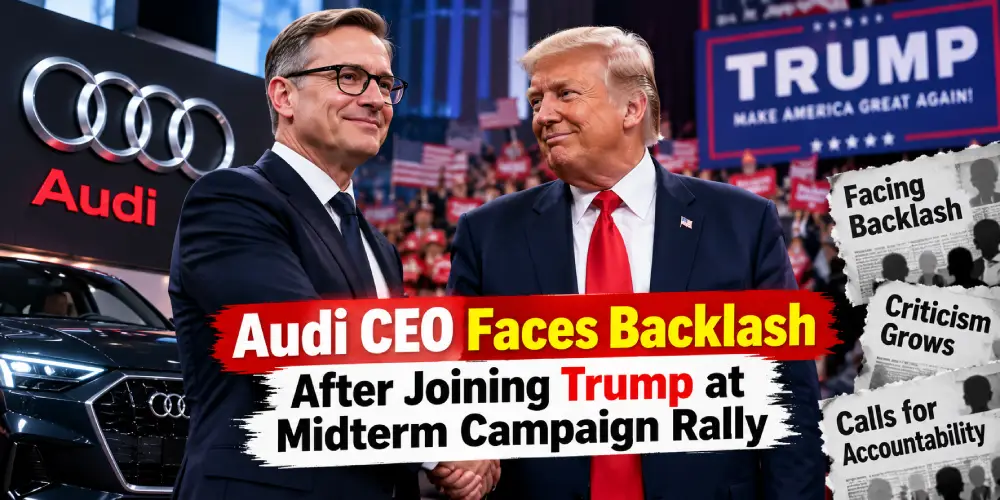
Audi CEO Gernot Döllner is facing criticism in Germany after appearing alongside US President Donald Trump at a campaign rally in Georgia. The October 24 appearance was intended to announce Audi’s planned investment in a new American manufacturing facility, but it has sparked a debate about corporate political neutrality, German jobs, and the relationship between business and election campaigning.
The controversy comes just days before the November 3, 2026, US midterm elections. While Trump presented Audi’s proposed investment as a victory for American manufacturing, German union leaders and political figures questioned whether the company’s chief executive should have participated in a campaign event.
Why Is Audi’s CEO Facing Criticism?
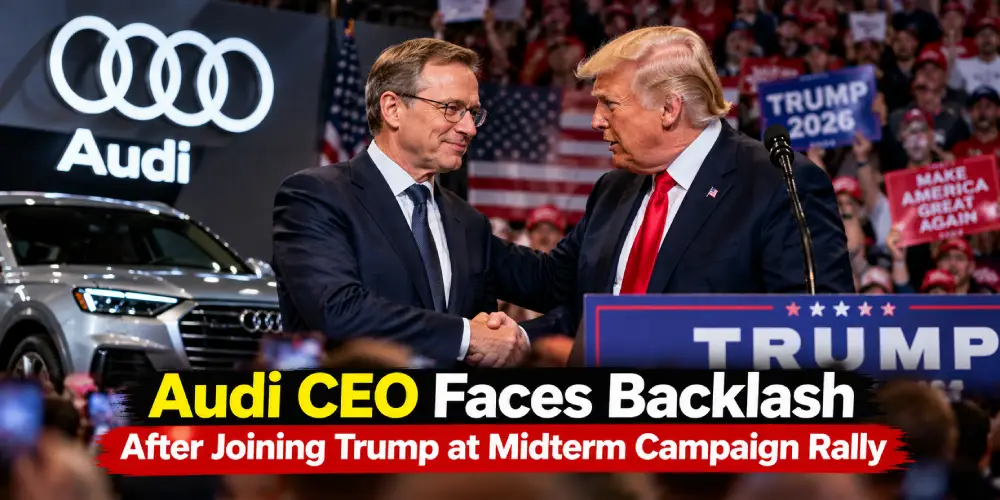
Döllner joined Trump onstage at a rally in Perry, Georgia, where the president announced Audi’s plan to establish its first US factory in the state.
The proposed investment is worth approximately $4 billion, with the facility expected to produce up to 200,000 SUVs annually. Audi has said the project could create around 4,500 jobs, with construction planned to begin in 2027 and vehicle production expected in the early 2030s.
However, the political setting quickly overshadowed the business announcement.
Christiane Benner, head of Germany’s IG Metall trade union and deputy chair of Volkswagen’s supervisory board, described Döllner’s appearance as deeply embarrassing and politically unacceptable. She also questioned whether the executive had breached Audi’s internal guidelines on political neutrality.
Daniela Cavallo, chair of Volkswagen’s works council, was similarly critical. She argued that the company’s leadership had allowed itself to become part of Trump’s political messaging.
Their objections reflect concerns that a major international company should avoid appearing to endorse a political candidate, particularly during a closely contested election campaign.
Audi’s Proposed $4 Billion US Factory
Behind the controversy is a significant business decision for Audi.
The luxury carmaker currently lacks its own dedicated manufacturing plant in the United States, leaving it exposed to import tariffs on vehicles shipped into the American market. Reuters reported that these tariffs cost Audi approximately €1.2 billion in the previous year.
Local production could help the company reduce its exposure to import duties, strengthen its position in the American market, and make its large SUVs more competitive.
The proposed Georgia facility is expected to focus on Audi’s biggest and most premium SUVs. The investment could also support employment and expand automotive manufacturing in the region.
However, the proposal still requires approval from Volkswagen’s supervisory board. That means the announcement represents a proposed investment rather than a fully approved factory project.
For Trump, the announcement offered an opportunity to highlight his administration’s tariff policies as a way to attract manufacturing investment to the United States.
For Audi, the project could make commercial sense. The controversy concerns not only the investment itself but also the decision to announce it at a political rally.
German Unions Question Audi’s Political Neutrality
One of the most sensitive aspects of the dispute involves Audi’s internal rules.
According to reporting by Reuters, Audi’s code of conduct restricts public appearances involving political parties or politicians standing for election during the three months before an election. The rules also address sponsorship of such events.
Benner argued that Döllner’s appearance conflicted with these requirements.
However, the circumstances are not entirely settled. Reuters reported that a person familiar with the matter said Audi’s management board had approved an exception to the company’s code of conduct before the appearance.
The distinction matters: criticism that an executive violated a company policy is not the same as an established finding that a violation occurred.
The issue may therefore become a question of how Audi interprets its own rules, who authorised the exception, and whether the company’s leadership believes the decision was appropriate.
As the discussion continues, the episode could put additional pressure on Audi and its parent company, Volkswagen, to explain their approach to political neutrality.
Why German Workers Are Concerned
The backlash is also connected to Volkswagen’s wider restructuring plans.
The group has been dealing with intense competition, pressure on costs, difficulties in China, and the expensive transition towards electric vehicles. Volkswagen has also been working to reduce excess production capacity and cut costs in Germany.
Against that background, a multibillion-dollar investment in the United States has raised questions about the future of German manufacturing jobs.
Workers and union representatives are concerned about uncertainty surrounding domestic production sites while Audi plans to expand its American manufacturing presence.
Lower Saxony premier Olaf Lies, whose state is a major Volkswagen shareholder, also criticised the decision to make such a significant investment announcement at a campaign rally. He highlighted the concerns of employees who are already worried about their jobs.
The dispute illustrates a difficult balancing act for a global automaker: expanding production in a strategically important market while maintaining the confidence of workers and stakeholders at home.
At the same time, building vehicles closer to American customers could strengthen Audi’s long-term competitiveness. The commercial case for US production and the political controversy surrounding the announcement are separate questions, even though they have become closely linked.
What Does This Mean for Audi’s Reputation?
The immediate challenge for Audi is managing the public response without undermining the business case for the proposed factory.
Companies operating across international markets regularly engage with government officials over investment, employment, regulation, and trade. Such engagement is not unusual. However, appearing onstage at an election campaign rally is different from attending a routine business meeting or participating in an investment discussion.
The setting can create the impression that a company is helping a political campaign, even if its primary objective is commercial.
That is particularly sensitive for international brands that serve customers and employ workers with different political views.
For Audi, the controversy raises several questions:
- Corporate neutrality: How should company executives engage with political leaders during election campaigns?
- Internal governance: Who can approve exceptions to company rules, and how transparent should that process be?
- Employee confidence: How can management explain overseas expansion while workers at home face uncertainty?
- Brand reputation: Could the political association distract customers and stakeholders from the company’s products and long-term strategy?
The episode may also prompt other multinational companies to reconsider how they announce major investments during politically sensitive periods.
Is the Georgia Factory Still Going Ahead?
The proposed factory remains subject to Volkswagen supervisory board approval. The public announcement is therefore an important step, but it should not be confused with final approval of every element of the project.
If approved, the facility could give Audi a stronger manufacturing presence in the United States and help it respond to trade barriers affecting imported vehicles.
The expected production capacity of up to 200,000 SUVs annually and the projected creation of approximately 4,500 jobs would make the project a significant development for Georgia.
Nevertheless, the company will need to balance its American growth plans with concerns about jobs, restructuring, and governance in Germany.
The coming weeks could bring further clarification about the investment proposal and the questions raised by Döllner’s appearance.
Final Thoughts
Audi’s proposed US factory highlights the growing connection between global business decisions and political messaging.
From a commercial perspective, local production could help Audi navigate tariffs and strengthen its position in the American market. But announcing the investment alongside Donald Trump at a campaign rally has generated criticism from German union leaders and political figures who believe the setting undermined corporate neutrality.
The central issue is not simply whether Audi should manufacture vehicles in the United States. It is whether a major corporate executive should participate in an election campaign event to promote a business investment—and how that decision affects employees, governance, and public trust.
For Audi, the challenge now is to explain the business rationale, address concerns about its internal policies, and maintain confidence among workers and other stakeholders while the proposed investment moves through the approval process.
Sources for fact-checking
The article is based on recent reporting from these publications:

