



For years, some of the world’s largest technology companies have been the driving force behind the US stock market. Investors poured money into companies such as Apple, Microsoft, Nvidia, Amazon, Alphabet, Meta Platforms, and Tesla, attracted by their scale, strong businesses, and potential to benefit from artificial intelligence (AI).
But that leadership is facing a challenge.
Recent market analysis has highlighted a shift in which the so-called Magnificent Seven have struggled to keep pace with the broader stock market. Instead of automatically outperforming other companies, these technology giants are facing tougher questions about valuations, AI spending, and future earnings.
The change matters because Big Tech has become such an influential part of the US stock market. When these companies outperform, they can lift major indexes. When they fall behind, investors may discover that opportunities are emerging elsewhere.
What Does It Mean When Big Tech Loses to the Average Stock?
The headline refers to a change in relative stock-market performance. It does not necessarily mean that every major technology company is losing money or that all other stocks are rising.
The Magnificent Seven generally refers to Apple, Microsoft, Alphabet, Amazon, Nvidia, Meta Platforms, and Tesla. These companies have played an outsized role in the market’s performance during the AI boom.
However, investors can measure market performance in different ways. A market-cap-weighted index gives greater influence to the largest companies, while an equal-weighted index gives each constituent a more similar influence.
This distinction helps explain why the average stock can perform differently from a market dominated by a handful of technology leaders.
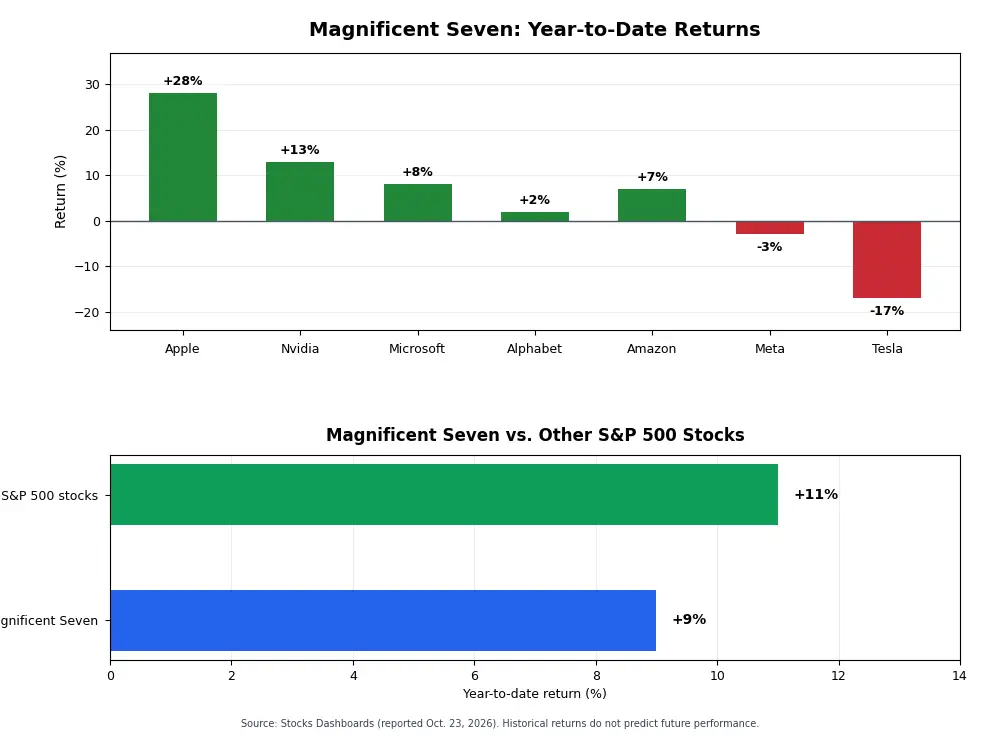
In July 2026, Morningstar reported that the Magnificent Seven had gained 5.5% on a market-cap-weighted basis through July 13, compared with a 10.6% gain for the Morningstar US Large-Mid Cap Index over the same period. The figures illustrated how the broader market had moved ahead of the group.
The important takeaway is that investors no longer have to rely exclusively on the biggest technology companies to find market growth.
Why Are Investors Rethinking Big Tech?
1. AI Spending Is Under Greater Scrutiny
Artificial intelligence remains one of the biggest long-term opportunities for technology companies. Businesses are investing in data centres, advanced chips, cloud infrastructure, and AI-powered products.
However, these investments require substantial amounts of capital.
Investors increasingly want evidence that spending will translate into sustainable revenue, stronger profit margins, and better cash flow. If companies spend heavily but cannot demonstrate adequate returns, their stock prices may come under pressure.
Yahoo Finance reported in June 2026 that major technology companies were facing questions about the profitability of their AI investments. At the same time, businesses supplying essential AI infrastructure were attracting investor attention.
This does not mean AI demand is disappearing. Instead, investors may be becoming more selective about which businesses are best positioned to benefit from it.
2. High Valuations Leave Less Room for Disappointment
Big Tech companies have often traded at premium valuations because investors expect them to deliver strong growth.
That premium can become a problem when expectations are too optimistic.
Even a financially successful company can experience a share-price decline if its earnings outlook falls short of what investors anticipated. Markets respond not only to business performance but also to the difference between actual results and expectations.
For technology giants, this creates a demanding environment. They must continue to grow while convincing investors that their future earnings justify their valuations.
3. Investors Are Looking Beyond the Biggest Companies
Another factor is the possibility of market rotation.
Market rotation occurs when investors move money from one group of stocks to another. For example, investors may reduce exposure to large technology companies and increase their holdings in industrial businesses, healthcare companies, financial firms, or suppliers serving the AI industry.
Axios reported in June 2026 that the original Magnificent Seven group had fallen behind the wider market, while some companies connected to the AI infrastructure boom were attracting interest.
Such a shift can broaden the market rally, although it does not guarantee that every smaller or less prominent company will perform well.
The Magnificent Seven Are Not Moving in the Same Direction
It is important not to treat the Magnificent Seven as a single business.
Each company has different sources of revenue, competitive strengths, spending requirements, and growth opportunities.
Apple depends heavily on its hardware ecosystem and services. Microsoft combines software, cloud computing, and AI services. Nvidia supplies chips used in AI infrastructure. Amazon has a major cloud business alongside its retail operations, while Alphabet and Meta rely heavily on digital advertising and are also investing in AI.
Tesla operates in a different competitive environment, with its performance influenced by electric vehicles, manufacturing costs, and expectations surrounding its technology initiatives.
These differences mean that one company can outperform while another struggles.
Morningstar’s July analysis noted that Apple and Nvidia helped support the group’s performance, even as the Magnificent Seven collectively lagged the broader market.
For investors, this makes company-level analysis increasingly important. A popular label or shared connection to AI is not enough to determine whether a stock represents good value.
What Could This Mean for the S&P 500?
The S&P 500 is a market-cap-weighted index, meaning companies with larger market values have a greater influence on its performance.
When a small number of mega-cap stocks dominate returns, the index can appear strong even when many individual stocks are struggling. Conversely, if the largest companies weaken while other stocks advance, the market’s overall performance may become less dependent on a few names.
A broader advance can be a positive sign because it suggests that market participation is expanding. However, investors should not assume that broader participation automatically means lower risk or that the rally will continue.
Interest rates, inflation, corporate earnings, economic growth, and geopolitical developments can all affect stock prices.
It is also important to compare the same time periods and index methodologies. A year-to-date return, a one-month return, and a performance figure measured over several years can tell very different stories.
Is Big Tech’s Dominance Coming to an End?
The recent underperformance does not establish that Big Tech has permanently lost its market leadership.
Large technology companies continue to operate major global platforms, generate substantial revenues, and invest in areas that could shape future economic growth. Their long-term prospects will depend on how successfully they turn those advantages into sustainable profits.
Periods of underperformance have occurred before. Investors sometimes shift their attention to other sectors, only for established market leaders to recover later.
The more useful question is whether each company’s future growth justifies its current valuation.
If AI investments produce strong commercial results, some technology stocks could regain momentum. If spending rises faster than revenue or competition reduces profitability, investors may favour other opportunities.
The outcome is unlikely to be identical for every company.
What Should Investors Watch Next?
Several indicators can help investors understand whether the shift away from Big Tech is continuing:
- Earnings growth: Are major technology companies delivering results that meet or exceed expectations?
- AI returns: Are AI products and services generating enough revenue to justify infrastructure spending?
- Market breadth: Are more companies participating in market gains, or are returns again concentrated in a few large stocks?
- Valuations: Do share prices reflect realistic expectations for future profits?
- Sector performance: Are industries outside mega-cap technology maintaining their relative strength?
Investors should also distinguish between short-term market movements and long-term business fundamentals. A stock’s recent performance alone cannot establish whether it is undervalued or likely to rise.
Final Thoughts
Big Tech’s changing relationship with the broader stock market is an important development for investors who have grown accustomed to a small group of companies driving market returns.
The Magnificent Seven remain influential, but their past dominance does not guarantee future outperformance. Questions about AI spending, valuations, earnings expectations, and competition are encouraging investors to look more closely at individual businesses and opportunities across other sectors.
The key lesson is not that Big Tech is finished. It is that market leadership can change, and investors should avoid assuming that the biggest companies will always deliver the strongest returns.
As the market evolves, earnings quality, reasonable valuations, and sustainable growth may matter more than a company’s size or popularity.