


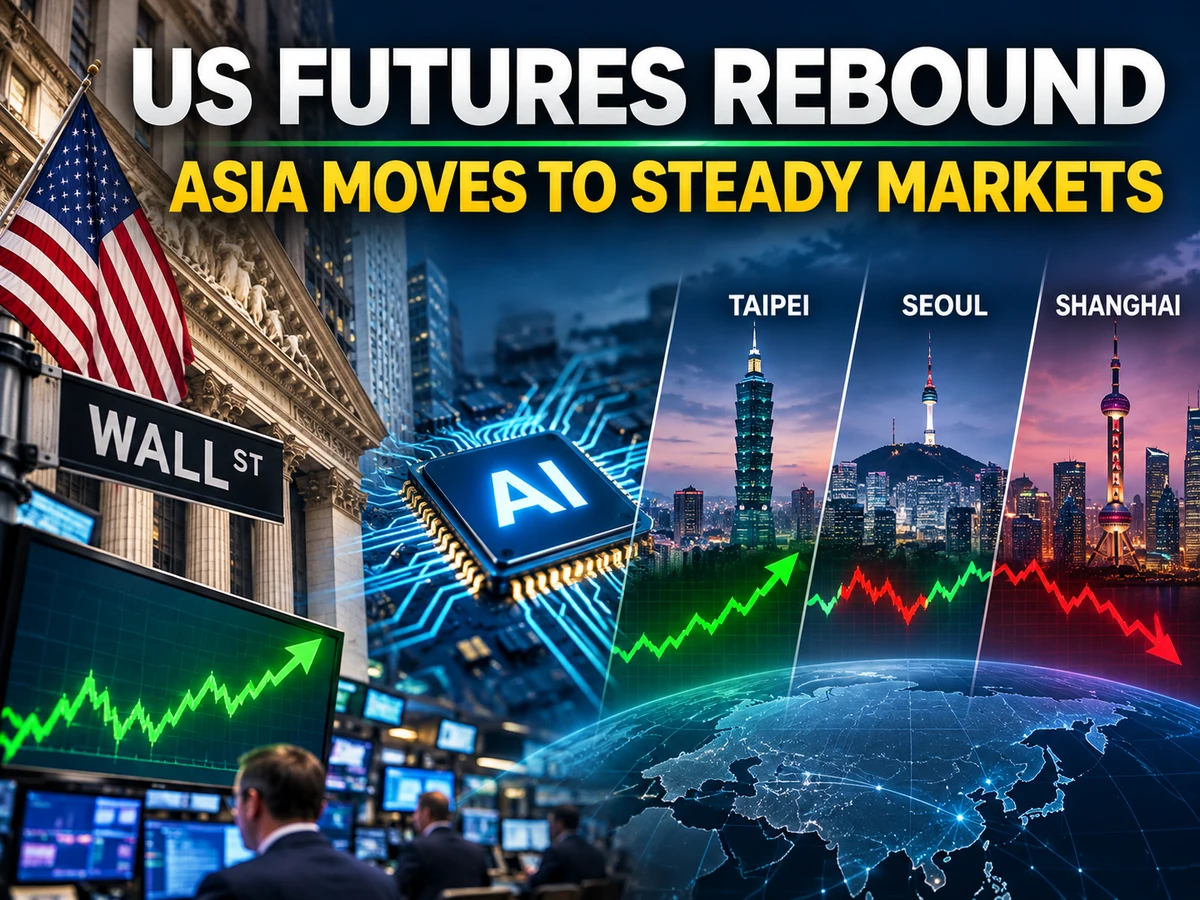

November 23, 2026 — The US stock futures rally gathered momentum Monday morning as technology shares attempted to recover from one of their steepest weekly declines in years. Wall Street was headed toward a sharply higher opening, but the picture across Asia remained uneven despite emergency measures designed to calm nervous investors.
Nasdaq-100 futures jumped 3.5% by 7:00 a.m. Eastern Time, while S&P 500 futures gained 2.8%, according to Reuters. Taiwan’s stock market rebounded, but South Korean shares continued falling as concerns over artificial intelligence spending, semiconductor valuations, and rising borrowing costs unsettled global markets.
For investors following financial and technology developments at DealInNow, Monday’s rebound offers a possible break from the selling. Whether it becomes a lasting recovery will depend on more than one strong morning of futures trading.
TL;DR
U.S. stock futures surged on November 23, 2026, following a sharp AI-driven market selloff. Nasdaq-100 futures gained 3.5%, while Taiwan’s market recovered after government intervention. South Korea remained under pressure, and China announced measures to support trading. Investors are now watching AI valuations, interest rates, and upcoming inflation data for evidence of a sustainable recovery.
Key Takeaways
- Nasdaq-100 futures rose 3.5% and S&P 500 futures climbed 2.8% by 7:00 a.m. ET Monday.
- The Nasdaq Composite lost approximately 10% last week, its worst weekly decline since March 2020.
- Taiwan’s benchmark index advanced 2.4%, while South Korea’s KOSPI was down about 3.3%.
- Taiwan, China, and South Korea introduced or prepared different measures to stabilize financial markets.
- Wednesday’s U.S. inflation report could influence expectations for the Federal Reserve’s next interest-rate decision.
Why US Stock Futures Are Rallying After the AI Selloff
Monday’s improvement follows a particularly damaging week for technology stocks.
The Nasdaq Composite fell roughly 10% last week as investors questioned whether the extraordinary amounts of money being committed to artificial intelligence infrastructure would produce sufficient returns.
The selloff extended beyond major technology companies. Semiconductor manufacturers, power suppliers, data-center operators, and businesses linked to AI infrastructure all faced pressure.
One concern is the gap between spending and profitability.
Building advanced AI systems requires expensive chips, enormous data centers, electricity, and networking infrastructure. Companies are spending billions to secure these resources, but the timing and scale of future profits remain uncertain.
Rising interest rates have made that calculation more difficult. Higher borrowing costs can reduce the appeal of investments whose expected returns may take years to materialize.
Nvidia and Semiconductor Stocks Lead the Rebound
Technology shares showed signs of recovery in Monday’s premarket session.
According to the Associated Press, Nvidia gained about 8.2% in premarket trading, while Advanced Micro Devices rose 4.3% and Broadcom climbed 5.5%.
The rebound came after sharp declines in AI-related stocks during the previous week.
Nvidia has also faced leadership uncertainty following Jensen Huang’s departure as CEO, adding another concern for investors evaluating the future of AI infrastructure financing.
Still, a strong premarket recovery does not establish that selling pressure has ended. Investors may be buying shares after steep losses, closing bearish positions, or adjusting portfolios ahead of the holiday-shortened trading week.
Asian Stock Markets Respond Differently to Emergency Support
Governments and financial regulators across Asia have taken increasingly visible steps to limit market volatility.
Their responses vary because the pressures facing each market are not identical.
| Market | Monday’s performance | Policy response |
|---|---|---|
| Taiwan | Up approximately 2.4% | Short-selling restrictions and a market stabilization fund |
| South Korea | Down approximately 3.3% | Stabilization fund preparations and relaxed share-buyback rules |
| Mainland China | Major indexes under pressure | Lower planned margin financing requirements |
| Japan | Markets closed | No regular stock trading due to a holiday |
Market changes reflect Reuters’ November 23 reporting and are not final U.S. closing figures.
Taiwan Tightens Short-Selling Rules
Taiwan’s market had been among the hardest hit during the global retreat from technology stocks.
The island is central to semiconductor manufacturing, making its market particularly sensitive to changing expectations for AI demand.
On November 21, Taiwan’s Financial Supervisory Commission announced additional restrictions on short selling. The measures included broader limits on short sales of stocks that had declined during the previous trading session and higher collateral requirements.
The changes took effect Monday.
Taiwan also has a National Financial Stabilization Fund of approximately NT$500 billion, equivalent to about $15 billion, authorized to support the market.
The measures helped restore some confidence, although they do not eliminate the underlying risks facing chipmakers.
South Korea Prepares Financial Market Support
South Korea experienced a different outcome.
Its benchmark KOSPI remained sharply lower despite government efforts to reassure investors.
On November 22, the country’s Ministry of Finance and Economy announced preparations that would allow its Stock Market Stabilization Fund to be activated when necessary.
Authorities also agreed to ease certain restrictions on daily corporate share repurchases for three months beginning November 24.
The distinction matters: South Korea was preparing its stabilization fund for possible activation, not confirming that it had already deployed the fund.
Finance Minister Lee Hyoung-il reiterated Monday that additional contingency measures remained available.
The market’s continued weakness demonstrates how difficult it can be to restore investor confidence when major semiconductor companies are under pressure.
China Moves to Increase Market Liquidity
Chinese authorities adopted another approach.
Stock exchanges announced measures intended to encourage trading and improve liquidity, including a reduction in minimum margin financing requirements.
The minimum margin ratio for eligible leveraged stock purchases is scheduled to decline from 100% to 80% beginning November 30.
The change would allow eligible investors to borrow more relative to the collateral they provide.
Exchanges also outlined lower trading costs and additional market-making initiatives.
These policies may support market activity, but easier borrowing can introduce additional risks if stock prices continue declining.
Is the AI Stock Market Selloff Really Over?
Monday’s recovery presents an encouraging signal, but investors have several reasons to remain cautious.
First, the underlying debate about AI investment returns has not been resolved. Strong demand for computing power does not automatically guarantee attractive profits for every company supplying it.
Second, semiconductor stocks have become important drivers of major indexes. When those shares fall together, broad investment portfolios can suffer even if many other businesses remain financially healthy.
Third, monetary policy remains a major influence.
The Federal Reserve’s interest-rate decisions affect financing costs, stock valuations, and expectations for future economic growth.
A short-term rebound can occur within a broader downtrend, particularly after an unusually severe selloff.
For individual investors, the difference between a temporary relief rally and a sustained recovery may become clearer only after several trading sessions.
What Wall Street Will Watch Next
A few scheduled developments could help determine whether the market can maintain Monday’s gains.
November 24 — Corporate earnings: Investors will examine Dell’s results and outlook for additional evidence about demand for AI-related computing infrastructure.
November 25 — U.S. inflation data: The Bureau of Economic Analysis is scheduled to release October’s Personal Consumption Expenditures Price Index at 8:30 a.m. ET. The PCE index is an important inflation measure closely watched by the Federal Reserve.
November 26 — Thanksgiving: U.S. stock markets will be closed.
November 27 — Shortened trading session: The New York Stock Exchange is scheduled to close its regular equity session at 1:00 p.m. ET.
Lower holiday-week trading volumes can sometimes amplify market movements, making it important to distinguish price swings from lasting changes in investor sentiment.
What the Global Market Rebound Means for U.S. Investors
The events of November 23 illustrate how closely connected American technology companies and Asian semiconductor markets have become.
AI spending decisions in the United States influence chip demand in Taiwan and South Korea. In turn, instability in those markets can affect the outlook for American technology stocks and investment funds.
Monday’s recovery suggests investors are reconsidering some of last week’s most aggressive selling.
It does not mean concerns about AI valuations, borrowing costs, or infrastructure spending have disappeared.
The immediate question is whether technology shares can hold their gains when regular U.S. trading resumes. The more important test is whether companies can demonstrate that their enormous AI investments will generate returns sufficient to justify market expectations.
Disclaimer: This article is for general informational and news purposes only and does not constitute investment or financial advice. Stock prices, futures, and market conditions can change rapidly. Readers should verify market data and consult qualified financial professionals before making investment decisions.