


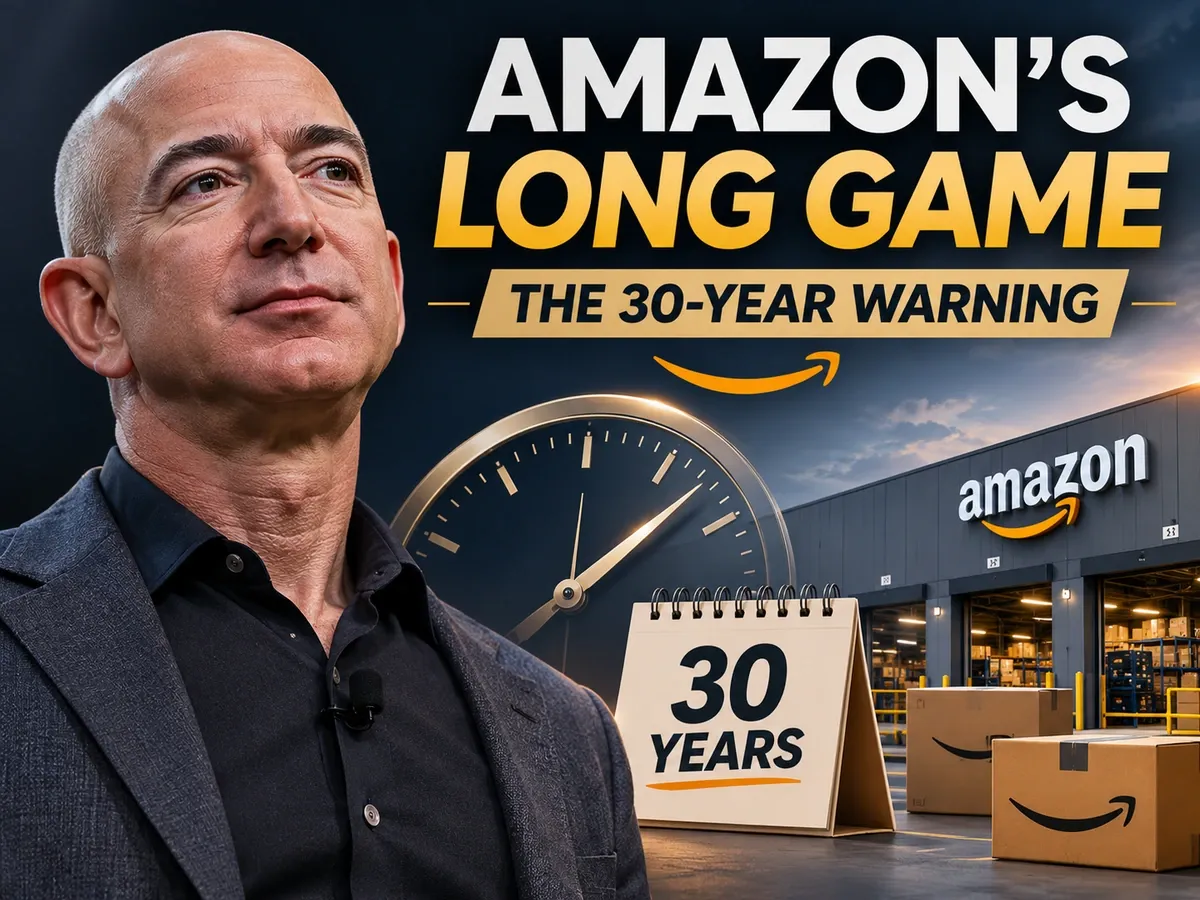

An Amazon bankruptcy warning from Jeff Bezos is drawing fresh attention in November 2026, raising questions about how long even the world’s most powerful companies can survive. But the billionaire founder’s comments are not new. They date back to a 2018 employee meeting, when Bezos challenged the idea that Amazon’s enormous size could protect it from eventual failure.
The remarks have gained renewed relevance as Amazon moves further into artificial intelligence, cloud computing, advertising, and digital retail. For readers following major business developments at DealInNow, the important question is not whether Amazon has a bankruptcy deadline, but whether the company can continue adapting as its markets change.
More than eight years after Bezos issued his warning, Amazon is still expanding. Its latest financial results show substantial revenue and operating profits, alongside increasingly expensive investments in AI infrastructure.
TL;DR
Jeff Bezos warned Amazon employees in 2018 that the company could eventually fail, arguing that large corporations often have shorter lifespans than people expect. His remarks have resurfaced in 2026, but they were never a prediction of bankruptcy within 30 years. Amazon’s latest results show strong growth, making his warning primarily a lesson about corporate complacency.
Key Takeaways
- Bezos made his bankruptcy prediction during an internal Amazon meeting in November 2018.
- His 30-year observation was a general warning about corporate longevity, not a specific deadline for Amazon.
- Amazon, founded in 1994, is now more than 32 years old.
- The company reported $201.9 billion in third-quarter 2026 revenue, up 12% year over year.
- Bezos believed customer obsession, innovation, and adaptability were essential to delaying corporate decline.
What Jeff Bezos Actually Said About Amazon Going Bankrupt
In November 2018, Bezos addressed employees at an all-hands meeting in Seattle. An employee had asked what Amazon could learn from the struggles of established retailers, including Sears, which had filed for Chapter 11 bankruptcy protection the previous month.
Bezos did not respond by celebrating Amazon’s competitive advantages.
Instead, he acknowledged that its success offered no guarantee of permanent survival.
According to CNBC’s original reporting, based on a recording of the meeting, Bezos said, “Amazon is not too big to fail.”
He went further, predicting that Amazon would eventually go bankrupt and suggesting that large companies frequently survive for decades rather than centuries.
The remarks attracted attention because Amazon was already one of America’s most influential businesses. Its expansion had transformed shopping habits, delivery expectations, and the economics of traditional retail.
Bezos was not announcing financial trouble. He was arguing that corporate dominance can create a dangerous sense of security.
The immediate lesson was straightforward: success in one generation does not guarantee relevance in the next.
The Amazon Bankruptcy Warning and the 30-Year Question
The most widely discussed part of Bezos’ comments was his reference to the lifespans of large corporations.
Founded in July 1994, Amazon was approximately 24 years old when he made those remarks. By July 2026, it had completed 32 years.
At first glance, that makes his observation appear especially significant. But there is an important distinction between an estimate about corporate longevity and a prediction that a particular business will collapse at a specific age.
Why the 30-Year Figure Is Not a Bankruptcy Deadline
Bezos did not establish a formal rule requiring companies to disappear after three decades. Nor did he identify a particular year when Amazon would fail.
Corporate survival statistics can vary considerably depending on what researchers measure. A company’s removal from a major stock index, for example, does not necessarily mean that the business has gone bankrupt.
Organizations can leave an index because of acquisitions, mergers, declining valuations, or changes to index composition.
The broader concern is that large businesses sometimes struggle to respond when technology, competition, and consumer behavior change.
Sears provided a powerful example in 2018. Once a dominant American retailer, it had lost relevance as shopping shifted toward newer formats and online platforms.
Bezos appeared determined to ensure that Amazon would not eventually become the next company overtaken by a business model it failed to anticipate.
Customer Obsession Was Bezos’ Answer to Corporate Decline
Bezos’ comments were consistent with a philosophy he had discussed publicly long before the employee meeting.
In his 2016 shareholder letter, published in April 2017, he described the difference between what he called Day 1 and Day 2 companies.
Day 1 represented urgency, invention, and a continuing willingness to improve customer experiences.
Day 2 represented stagnation, followed by an extended period of declining relevance.
His proposed defense included listening closely to customers, resisting unnecessary bureaucracy, embracing emerging trends, and making decisions without allowing organizational complexity to become an obstacle.
Why Successful Companies Can Lose Their Advantage
A company can deliver strong financial results while gradually becoming less responsive to its market.
Established products may continue generating revenue even as customer expectations shift. Internal procedures can become more important than outcomes, while management teams may prioritize protecting existing businesses over developing potential replacements.
This is particularly relevant for technology companies, where new platforms can alter competitive conditions relatively quickly.
Amazon’s development illustrates why reinvention matters. What began as an online bookstore eventually expanded into cloud infrastructure, third-party marketplaces, digital advertising, subscriptions, and numerous other businesses.
Those changes were not inevitable. They required investment in opportunities that were initially separate from Amazon’s original retail business.
Amazon’s 2026 Financial Results Tell a Different Story
Amazon’s financial position in late 2026 is far removed from the conditions associated with an imminent corporate collapse.
According to its October 29, 2026 earnings release, the company reported continued revenue growth and substantial operating income.
| Financial metric | Reported result |
|---|---|
| Full-year 2025 net sales | $716.9 billion |
| Q3 2026 net sales | $201.9 billion |
| Q3 2026 revenue growth | 12% year over year |
| Q3 2026 operating income | $28.1 billion |
| Q3 2026 net income | $20.7 billion |
| Q3 2026 AWS sales | $46.0 billion |
Amazon Web Services, the company’s cloud-computing division, posted approximately 39% year-over-year sales growth during the third quarter.
That performance demonstrates how far Amazon has moved beyond the online retail model that originally established its business.
However, strong operating performance does not eliminate all financial risks.
Amazon reported negative free cash flow of $42.4 billion for the 12 months ending September 30, 2026. The company attributed the decline primarily to a substantial increase in capital expenditures, especially investments connected to artificial intelligence.
Negative free cash flow deserves attention, but it is not equivalent to bankruptcy. Amazon simultaneously reported substantial operating cash generation.
For investors, the central question is whether today’s expensive infrastructure investments will generate sufficient long-term returns.
AI Spending Creates a New Test for Amazon’s Future
Amazon’s next phase is increasingly tied to artificial intelligence.
Its cloud business provides computing infrastructure to companies building and operating AI systems, while its retail operations are incorporating automation and AI-powered services.
These opportunities also carry significant costs.
Data centers, networking equipment, advanced chips, and supporting infrastructure require major spending before the related investments necessarily produce returns.
Amazon must therefore balance aggressive expansion with financial discipline.
The company also faces competition across several markets. Microsoft and Google challenge AWS in cloud computing, while Walmart and other retailers compete for consumer spending.
Regulatory scrutiny introduces additional uncertainty, particularly around competition, advertising practices, and marketplace operations. Allegations and pending legal proceedings should not be mistaken for findings of wrongdoing.
None of these factors establishes that Amazon is approaching bankruptcy. They do, however, illustrate why maintaining market leadership demands continuous adjustment.
How Andy Jassy Is Carrying Amazon Beyond Its Founder
Bezos stepped down as Amazon’s chief executive in July 2021 and became executive chair. Andy Jassy, who previously led AWS, took over as CEO.
That leadership transition created another test of the company’s ability to maintain its culture without Bezos managing daily operations.
Jassy now oversees a business that is substantially larger and more diversified than the Amazon of 2018.
The strategic challenge is also more complicated. Amazon must serve price-conscious shoppers, support millions of business customers, maintain extensive logistics operations, and compete in a rapidly developing AI industry.
Bezos’ underlying message remains relevant because organizational size can make change harder even when a company has the resources to fund it.
What Bezos’ Warning Really Means in 2026
Amazon has already passed the 30-year milestone that renewed interest in Bezos’ original remarks. Its latest financial performance shows that the company remains a major force in U.S. retail and global technology.
Yet the founder’s central argument was never that Amazon would suddenly collapse when it reached a particular birthday.
It was that corporate survival must be earned repeatedly.
The company’s future will depend less on how long it has existed than on how effectively it responds to changes in customer behavior, competition, technology, and capital requirements.
For Amazon, the test is no longer simply whether it can dominate online shopping. It is whether a 32-year-old company can continue operating with the urgency that helped make it successful.
Disclaimer: This article is provided for general news and informational purposes only. It does not constitute investment or financial advice. Corporate forecasts, financial results, legal developments, and market conditions may change. Readers should review official company filings and consult a qualified financial professional before making investment decisions.