


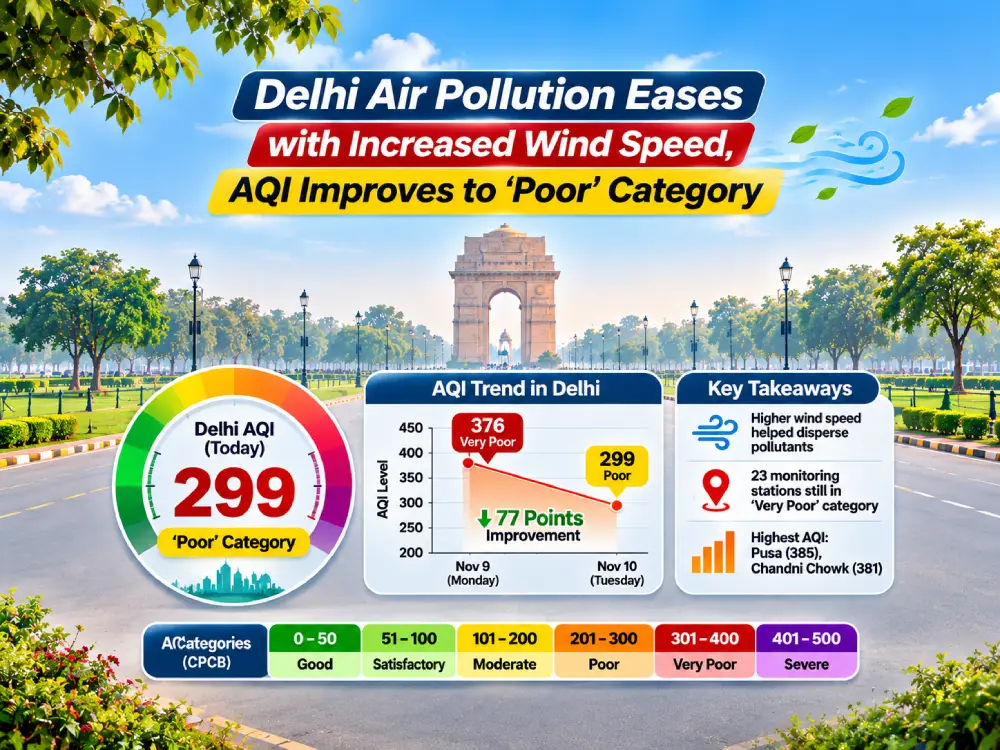

Delhi residents got a little relief from air pollution on Tuesday, November 10, as stronger winds helped clear some of the pollutants hanging over the city.
The average Air Quality Index (AQI) dropped to 299, bringing Delhi out of the ‘very poor’ category and into the ‘poor’ category. A day earlier, on November 9, the city’s AQI stood at 376 following the Diwali celebrations.
While the improvement is welcome, Delhi’s air is still far from clean. Several areas continue to record high pollution levels, making it important for residents to remain cautious.
Delhi’s AQI Improves After a Rise in Wind Speed
The improvement in air quality came as wind speed increased across the region. Stronger winds helped disperse some of the pollutants that had built up in the air during the post-Diwali period.
According to CPCB data, Delhi’s average AQI fell from 376 on Monday to 299 on Tuesday.
An AQI of 299 falls within the ‘poor’ category, which means pollution levels have come down but can still cause breathing discomfort, particularly for people who are sensitive to air pollution.
Several Areas Still Face Very Poor Air Quality
Although the overall AQI improved, pollution levels remain high in several parts of Delhi.
Data from the Central Pollution Control Board showed that 23 monitoring stations were still reporting ‘very poor’ air quality on Tuesday.
Pusa recorded the highest AQI at 385, followed by Chandni Chowk at 381. AQI readings were available from 57 out of Delhi’s 59 monitoring stations.
This shows why looking only at the city’s average AQI may not tell the whole story. Air quality can vary considerably from one neighbourhood to another.
Why Stronger Winds Make a Difference
Wind speed can have a noticeable impact on Delhi’s air quality, especially during periods when pollution levels are already high.
When the air remains relatively still, pollutants can build up near the ground. Stronger winds help move and disperse these pollutants, sometimes leading to a temporary improvement in AQI readings.
That appears to have helped Delhi this week.
However, wind alone cannot solve the city’s pollution problem. Vehicle emissions, road and construction dust, industrial pollution, waste burning and other sources continue to affect air quality.
Delhi AQI Categories: What Do the Numbers Mean?
The CPCB uses six categories to describe air quality in India. Here’s a quick look at what the readings mean.
| AQI Reading | Category |
|---|---|
| 0–50 | Good |
| 51–100 | Satisfactory |
| 101–200 | Moderate |
| 201–300 | Poor |
| 301–400 | Very Poor |
| 401–500 | Severe |
With an average AQI of 299, Delhi is still at the upper end of the poor category. Even though the reading has improved, residents should not assume that the air is now safe for everyone.
What Should Delhi Residents Do?
For now, it makes sense to keep an eye on local air quality, particularly if you live in an area where pollution levels remain high.
Children, older adults and people with existing respiratory or heart conditions should take extra care when AQI levels are elevated.
A few sensible precautions can help:
- Check the latest AQI before spending long periods outdoors.
- Avoid strenuous outdoor exercise when pollution levels are high.
- Keep windows closed during periods of heavy pollution.
- Follow official health and air-quality advisories.
A Small Improvement, but Delhi Still Needs Cleaner Air
The fall in Delhi’s AQI from 376 to 299 is encouraging, especially after the rise in pollution around Diwali. Increased wind speed has helped disperse some of the polluted air, giving residents a little breathing space.
But the situation is not yet under control. With several monitoring stations still reporting very poor air quality, the improvement should be seen as temporary relief rather than a lasting solution.
Delhi needs consistent efforts to reduce pollution at its source, not just favourable weather conditions.
Source note: This report uses CPCB figures reported by news outlets on November 10, 2026. AQI readings may change throughout the day.
Disclaimer: This article is for general information and is not medical advice.