




Alphabet, the parent company of Google, faced a potentially historic stock-market sell-off on October 29, 2026, as investors reacted to disappointing quarterly results, weaker-than-expected search advertising performance, and rising artificial intelligence spending.
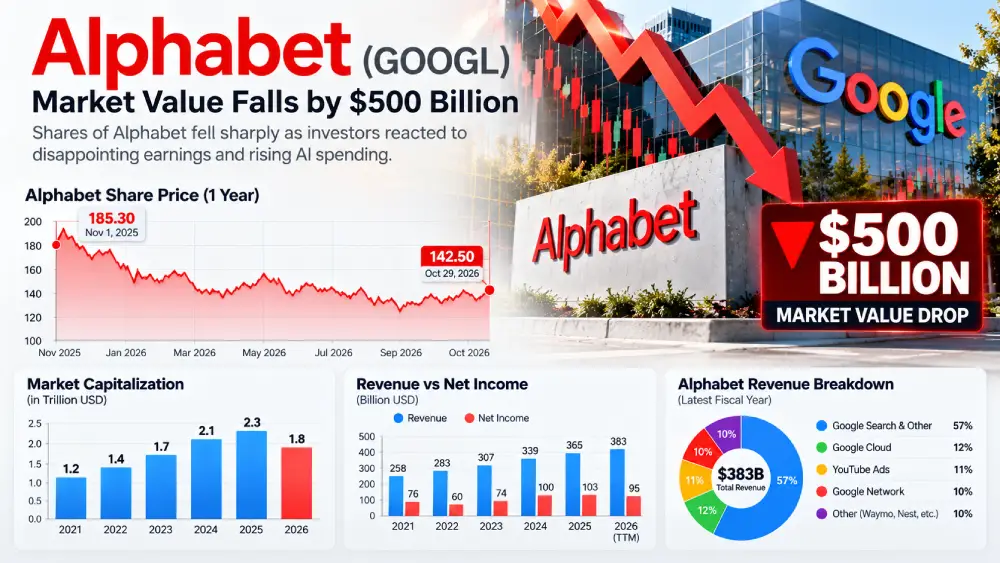
The company’s shares fell sharply during Thursday’s trading session, putting approximately $500 billion in market value at risk. The decline highlighted a growing challenge for major technology companies: investors want evidence that massive AI investments will generate sustainable revenue and profits.
Although Alphabet continues to invest heavily in AI and has reported strong growth in its cloud business, concerns about advertising performance, cash flow, and future spending weighed on investor sentiment.
Alphabet Shares Face a Historic Decline
Alphabet’s shares fell approximately 12% to 13% during Thursday’s session, putting the company on course for one of the largest single-day losses in market value recorded by a US-listed company.
According to Yahoo Finance, the potential loss approached $500 billion, which would make it Alphabet’s largest market-value decline to date. Whether that amount represents the final loss depends on the closing share price and the market’s subsequent movements.
The scale of the sell-off reflects how sensitive investors have become to earnings results from major technology companies. When a company with an enormous market valuation disappoints on important financial measures, even a relatively modest change in investor expectations can translate into hundreds of billions of dollars in market value.
Why Did Alphabet Stock Fall?
Several factors contributed to the negative reaction, including disappointing advertising results, concerns about AI competition, and the cost of expanding computing infrastructure.
1. Google Search Advertising Growth Disappoints
Google Search remains one of Alphabet’s most important businesses. Advertising revenue generated through search helps finance the company’s investments in AI, cloud computing, and other digital services.
However, its latest quarterly results showed that search advertising performance fell short of Wall Street expectations.
Yahoo Finance reported that search revenue grew by approximately 12% to around $63 billion, below analysts’ expectations of roughly $65 billion. Although the business continued to grow, investors were concerned that the results did not fully justify the company’s valuation and investment commitments.
The concern is not necessarily that Google Search is disappearing. Rather, investors are trying to determine whether changing search habits and new AI-powered experiences could affect advertising growth and profitability over time.
2. Artificial Intelligence Spending Is Increasing
Alphabet is investing heavily in data centers, specialized computing equipment, and other infrastructure needed to develop and operate advanced AI systems.
These investments can strengthen its competitive position, but they also create significant financial commitments. Building infrastructure requires substantial spending before the resulting services necessarily generate enough revenue to cover those costs.
Reports on the company’s latest results highlighted elevated capital expenditure and pressure on free cash flow. Financial Times reporting put third-quarter capital expenditure at approximately $51.3 billion and free cash flow at negative $9.1 billion.
Investors are increasingly focused on whether AI-related spending will produce returns that justify its scale.
For Alphabet, the challenge is to continue developing competitive AI products without allowing infrastructure costs to undermine profitability or financial flexibility.
3. AI Could Change How People Search Online
The growth of conversational AI tools is creating new competition for traditional search engines.
Instead of entering a query and selecting a list of websites, users can increasingly ask AI assistants to summarize information, compare products, and answer questions directly.
This change could affect how users discover websites and how advertisers reach potential customers.
Alphabet is responding by integrating AI into Google Search and expanding its own AI products. However, introducing these features also creates questions about monetization, advertising placement, and the economics of answering queries through AI-generated responses.
Investors need to understand whether these new experiences can preserve Google’s advertising strengths while meeting the cost of providing increasingly sophisticated AI services.
Google Cloud Provides a Bright Spot
Despite the pressure on its shares, Alphabet’s results were not uniformly negative.
Google Cloud reported revenue of approximately $30.7 billion for the quarter, according to reports on the earnings announcement. Its performance offered evidence that demand for cloud computing and AI-related services remains an important growth opportunity for the company.
Cloud services can benefit from businesses seeking computing capacity, data storage, AI infrastructure, and enterprise software.
Strong cloud demand could help Alphabet diversify its revenue beyond advertising. However, investors must also consider the infrastructure costs associated with meeting that demand.
The key question is whether growth in cloud computing and AI services can generate sufficient operating profits and cash flow to support the company’s long-term investment plans.
Alphabet’s Sell-Off Highlights the Risks Facing Big Tech
Alphabet’s market-value decline reflects a broader issue facing major technology companies: expectations have risen alongside their stock valuations.
Investors have rewarded businesses that demonstrate strong growth in cloud computing, AI, digital advertising, and related services. At the same time, the cost of competing in these markets has increased.
When companies announce significant spending plans, investors increasingly want evidence of measurable returns rather than promises of future growth.
Alphabet’s experience also illustrates why strong performance in one business segment may not always offset disappointment elsewhere. Cloud growth can be encouraging, but weaker search advertising and negative free cash flow can still create uncertainty about the overall business.
For investors, this means looking beyond headlines and evaluating revenue growth, profit margins, cash generation, capital expenditure, and competitive risks together.
What Investors Should Watch Next
Alphabet’s future performance will depend on its ability to balance investment in emerging technologies with the financial strength of its established businesses.
Several developments deserve attention in the coming quarters.
Search advertising performance: Investors will watch whether advertising revenue growth stabilizes and how AI-powered search experiences affect monetization.
AI investment returns: The market will look for evidence that spending on data centers, computing infrastructure, and AI models is producing sustainable revenue and profits.
Google Cloud profitability: Continued cloud growth could strengthen Alphabet’s business mix, particularly if it translates into stronger operating income and cash generation.
Free cash flow: Investors will monitor whether capital expenditure continues to pressure cash flow or whether revenue growth begins to offset the investment burden.
Competitive pressure: Developments involving AI assistants, competing cloud providers, and changes in online search behavior could influence Alphabet’s long-term strategy.
These indicators may provide a clearer picture of the company’s financial position than any single day’s stock-price movement.
Conclusion
Alphabet’s potential $500 billion market-value decline underscores the growing pressure on technology companies to demonstrate that their AI investments can deliver sustainable financial returns.
The company continues to benefit from major businesses in search advertising, cloud computing, and AI. However, disappointing advertising results, rising infrastructure costs, and pressure on free cash flow have raised questions about how effectively it can balance innovation with profitability.
The long-term outcome will depend on whether Alphabet can turn its investments into durable growth while defending its core search business.
For investors, the episode is a reminder that even the world’s largest technology companies remain vulnerable when market expectations collide with financial results.
This article is for informational purposes only and does not constitute investment advice.