


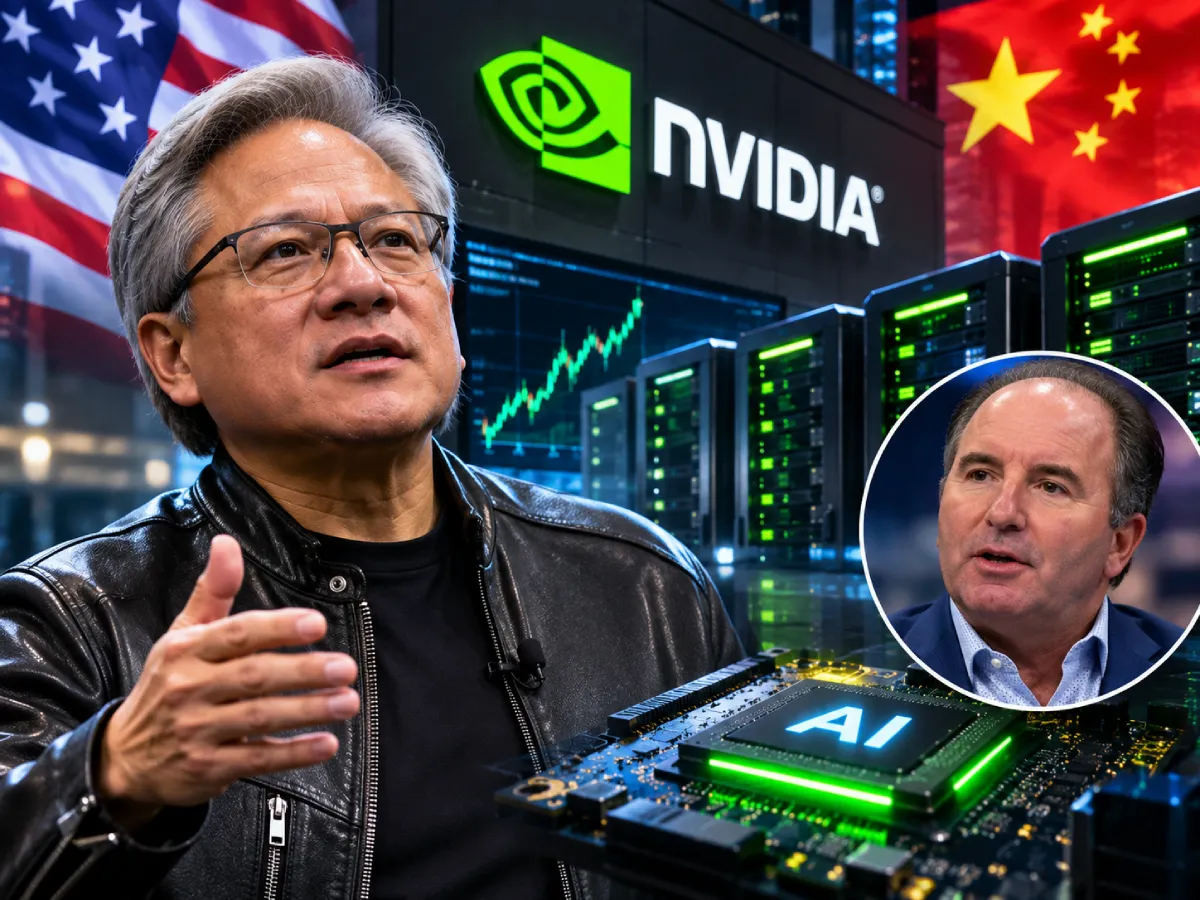

Nvidia AI spending expectations remain strong despite the departure of Jensen Huang, according to technology analyst Dan Ives, who believes the former CEO’s exit represents a major setback for the chipmaker and America’s competition with China. The leadership upheaval has unsettled investors, but Ives argues that the broader artificial intelligence boom is far from finished.
Huang resigned from Nvidia on November 12, 2026, ending more than three decades of leadership at the company he co-founded. The announcement sent shockwaves through the technology industry at a time when investors were already questioning the enormous sums being invested in AI infrastructure.
Ives believes Huang’s absence could reduce Nvidia’s valuation by approximately $1 trillion. Nevertheless, he continues to forecast between $3 trillion and $4 trillion in industry-wide AI capital spending over the coming years.
For readers following technology stocks and AI investment trends on DealInNow.com, the situation raises a fundamental question: Can Nvidia maintain its extraordinary growth without the executive who helped make it the dominant supplier of AI computing technology?
TL;DR
Technology analyst Dan Ives believes Jensen Huang’s departure could cost Nvidia approximately $1 trillion in market valuation and give Chinese competitors an opportunity to narrow the technology gap. However, he maintains that global AI infrastructure investment could reach $3 trillion to $4 trillion over the coming years. Nvidia’s latest earnings show strong demand for its chips, despite uncertainty over its future leadership.
Key Takeaways
- Major leadership change: Jensen Huang resigned on November 12, with Colette Kress appointed interim Nvidia CEO.
- Potential valuation impact: Dan Ives estimates Huang’s departure could affect Nvidia’s valuation by approximately $1 trillion. This is an analyst assessment, not a confirmed loss directly attributable to his exit.
- China competition: Ives believes the transition could benefit Chinese AI technology companies.
- AI spending forecast: He still expects $3 trillion to $4 trillion in broader industry capital expenditures over the next several years.
- Business performance remains strong: Nvidia reported $115.8 billion in quarterly revenue, including $107.6 billion from its Data Center business.
Why Dan Ives Sees Jensen Huang’s Departure as a Major Blow
Jensen Huang was much more than Nvidia’s chief executive.
Since co-founding the company in 1993, he helped guide its transformation from a graphics processor manufacturer into a central supplier of the hardware powering artificial intelligence.
His leadership became closely associated with Nvidia’s product strategy, relationships with cloud computing companies and negotiations involving international semiconductor markets.
During a CNBC discussion reported by Benzinga, Ives described losing Huang as a “black eye moment” for Nvidia.
He estimated that Huang’s departure could account for approximately $1 trillion of the company’s market valuation.
That number reflects Ives’ judgment about Huang’s importance to investor confidence, not a precise calculation establishing that Nvidia shares lost $1 trillion solely because of the resignation.
The distinction is important because share prices respond to many factors, including earnings expectations, competition, economic conditions and investor sentiment.
Why China’s AI Industry Could Benefit From Nvidia’s Transition
Ives also characterized Huang’s departure as a “dream scenario for China.”
His argument centers on Nvidia’s position in the competition between American and Chinese technology companies.
Nvidia has helped establish the United States as a leading supplier of advanced AI processors and computing systems.
Huang also played an important role in discussions about semiconductor exports, technology restrictions and international market access.
His departure could create uncertainty over Nvidia’s future strategy toward China and the company’s relationships with American policymakers.
Chinese technology businesses, including Huawei and domestic semiconductor developers, have been working to expand their AI computing capabilities.
However, a leadership change at Nvidia does not automatically give those competitors a technological advantage.
Ives believes Nvidia remains approximately two to three years ahead of its closest competitors, although that assessment is difficult to measure consistently across different computing products and workloads.
U.S. export controls, domestic Chinese investment and technological development will continue influencing the competition.
The geopolitical implications also remain sensitive. California’s attorney general has opened an investigation involving Nvidia’s former leadership and reported concerns about Chinese access to advanced technology.
Those concerns are under investigation and should not be treated as proof that Huang or Nvidia transferred protected information unlawfully.
Nvidia AI Spending Forecast: Why Ives Still Sees a $4 Trillion Opportunity
Despite his concerns about leadership, Ives remains optimistic about the broader AI investment cycle.
He estimates that companies could spend approximately $3 trillion to $4 trillion on artificial intelligence infrastructure over the coming years.
The projected spending covers more than Nvidia’s products.
It includes investments in data centers, computing equipment, networking, power infrastructure and technology needed to deploy increasingly capable AI systems.
Major companies such as Microsoft, Amazon, Alphabet and Meta are investing heavily in computing capacity.
Demand also comes from AI developers and cloud infrastructure providers building systems for customers around the world.
The important distinction is that $4 trillion is an industry-wide spending forecast, not Nvidia’s revenue projection or a confirmed amount already spent.
Some of the investment could benefit competing semiconductor manufacturers, infrastructure suppliers and energy companies.
The forecast also depends on continued AI adoption and the willingness of businesses to finance large projects.
If economic conditions deteriorate or AI investments generate weaker-than-expected returns, actual spending could fall below projections.
Nvidia’s Latest Earnings Show Strong Demand Despite the CEO Crisis
Nvidia’s November 17 earnings report offered investors a clearer picture of its underlying business.
According to the company’s official third-quarter fiscal 2027 results, total revenue reached $115.8 billion, an increase of 103% compared with the same quarter a year earlier.
Data Center revenue reached $107.6 billion, up 110% year over year.
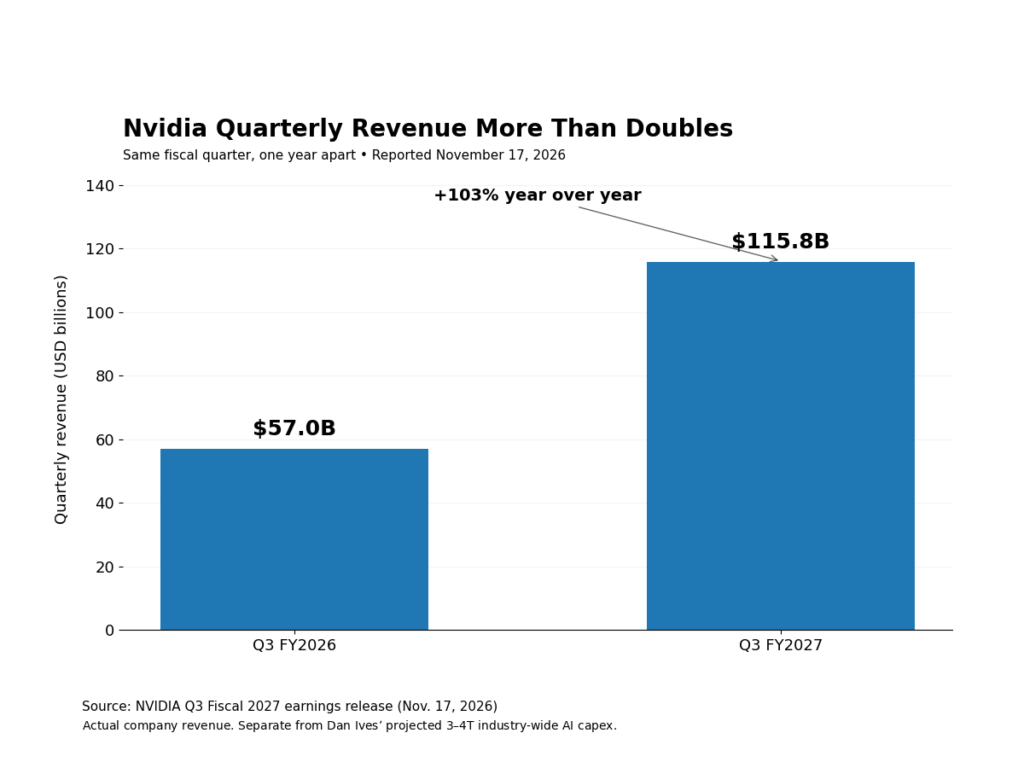
The figures demonstrate that demand for Nvidia’s computing platforms remained substantial during its latest reported quarter.
The company also highlighted progress with its Vera Rubin AI computing platform and expanded relationships with major cloud providers.
Its fourth-quarter outlook suggests management expects continued revenue growth.
Still, the figures reflect business performance and guidance, not a guarantee that Nvidia shares will recover quickly.
Colette Kress Faces the Challenge of Leading Nvidia Without Huang
Nvidia appointed longtime Chief Financial Officer Colette Kress as interim CEO following Huang’s resignation.
Kress joined Nvidia in 2013 and has played a central role in its financial management during the company’s rapid expansion.
The board has begun searching for a permanent chief executive, considering both internal and external candidates.
Nvidia’s chairman, Harvey Jones, has publicly ruled out reinstating Huang as CEO.
That decision creates an important leadership test.
The company’s engineering teams, product development programs and customer relationships remain in place, but investors will want evidence that the next permanent CEO can manage Nvidia’s complicated position within the AI industry.
The job includes overseeing advanced chip development, supply chains, strategic investments and relationships with governments.
Nvidia’s leadership has said its operations, customer commitments and technology roadmap are expected to continue without interruption.
However, maintaining that continuity while managing regulatory scrutiny and investor expectations will be a major responsibility.
Why Wall Street Still Believes in the AI Infrastructure Boom
Dan Ives is not the only market commentator who believes the broader AI investment story can survive Nvidia’s leadership crisis.
Fundstrat’s Tom Lee has also expressed optimism about the industry’s long-term prospects.
According to reporting on their market commentary, Lee sees the recent technology-sector weakness partly as a reaction to uncertainty and investors reducing risk rather than proof that AI demand has collapsed.
The successful Anthropic public offering has also provided evidence of continued investor interest in artificial intelligence businesses.
Anthropic’s record IPO attracted substantial capital, reflecting demand for exposure to companies developing advanced AI models.
Readers can find more context in our Anthropic IPO and Nasdaq trading coverage.
Still, an AI company’s ability to raise capital is different from its ability to generate lasting profits.
Investors remain concerned about whether the huge sums committed to AI infrastructure will eventually produce sufficient financial returns.
What Could Put Nvidia’s Growth at Risk?
Several developments could challenge Nvidia’s investment outlook.
Leadership uncertainty: The company must establish confidence in its permanent management team while maintaining its product roadmap.
China-related restrictions: U.S. export controls and additional regulatory scrutiny could limit access to certain markets.
Growing competition: AMD, custom-chip developers and Chinese semiconductor manufacturers are working to offer alternatives to Nvidia products.
High infrastructure costs: AI data centers require substantial spending on electricity, equipment, cooling and networking.
Customer investment decisions: Nvidia’s largest customers could change their spending plans if demand or financial returns disappoint.
None of these factors guarantees a decline, but together they show why Nvidia’s strong revenue growth does not eliminate investment risk.
What Investors Should Watch in NVDA Stock
The next major developments will involve Nvidia’s leadership search and how the company executes its AI product roadmap.
Investors should also watch future Data Center revenue, gross margins and spending commitments from major cloud customers.
Regulatory investigations and potential changes in U.S.-China semiconductor policy could influence the company’s operating environment.
Nvidia’s $130 billion fourth-quarter revenue outlook provides one measurable benchmark for assessing near-term business performance.
However, investors should distinguish between strong corporate earnings and an attractive stock valuation.
A company can report impressive results while its share price remains volatile if market expectations were already extremely high.
The Bigger Question Is Whether Nvidia Can Keep Its Advantage
Huang’s departure represents a significant change for Nvidia, particularly given his influence on the company’s development and the wider AI industry.
Dan Ives believes that leadership loss could create an opportunity for Chinese competitors while reducing investor confidence in the chipmaker.
Yet his broader investment thesis remains intact: businesses are still planning enormous AI infrastructure investments, and Nvidia remains one of the main suppliers positioned to benefit.
The company’s latest earnings support the argument that demand for advanced AI computing has not disappeared.
What remains unresolved is how Nvidia’s new leadership will handle competition, political scrutiny and the enormous expectations already reflected in the AI market.
For investors, that makes Nvidia’s future a question of execution as much as technology.
Financial disclaimer: This report is for informational purposes and does not constitute personalized investment advice.
Verified Sources
Nvidia — Official CEO Transition Announcement
https://investor.nvidia.com/news/press-release-details/2026/NVIDIA-Announces-CEO-Transition/
Nvidia — Third Quarter Fiscal 2027 Financial Results
https://investor.nvidia.com/news/press-release-details/2026/NVIDIA-Announces-Financial-Results-for-Third-Quarter-Fiscal-2027/
Benzinga — Dan Ives on Jensen Huang and $4 Trillion AI Spending
https://www.benzinga.com/markets/equities/26/11/63330847/nvdas-black-eye-moment-dan-ives-says-losing-jensen-huang-is-a-dream-scenario-for-china-but-wont-stop-4-trillion-ai-spending-theme
Reuters — Nvidia Board Rules Out Jensen Huang’s Return
https://www.reuters.com/business/nvidia-forecasts-quarterly-revenue-above-estimates-first-report-since-huangs-2026-11-17/
Reuters — California Attorney General Investigates Nvidia
https://www.reuters.com/legal/litigation/california-ag-subpoenas-nvidia-over-concerns-about-former-ceo-china-2026-11-19/
Associated Press — Technology Leaders React to Huang’s Departure
https://apnews.com/article/063310aae44182e67e55c04c5b1e29e4
CBS News — Jensen Huang Resigns as Nvidia CEO
https://www.cbsnews.com/news/nvidia-ceo-jensen-huang-resigns/