


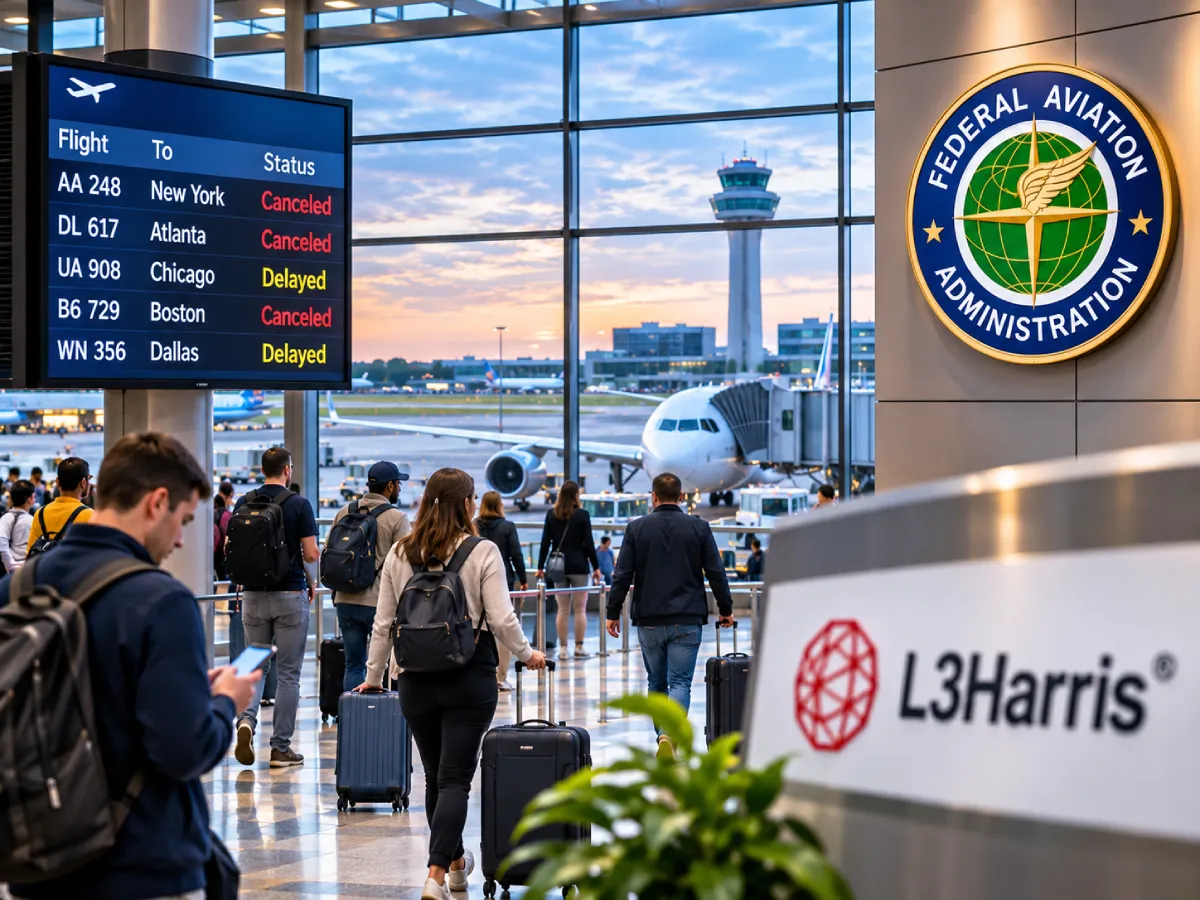

The FAA ground stop that brought U.S. air travel to a near standstill on Friday is now the focus of a technical investigation involving defence contractor L3Harris Technologies. Transportation Secretary Sean Duffy said Saturday that work to replace an aging telecommunications connection may have contributed to the failure, but investigators have not established exactly what went wrong.
More than 4,000 flights were canceled and another 3,000 delayed Saturday, November 14, as airlines struggled to restore normal operations following the shutdown.
The new findings provide more detail about the disruption, which affected airports across the country and left tens of thousands of travelers facing unexpected changes to their plans.
For readers following the latest U.S. news and consumer updates on DealInNow.com, the key development is that federal officials are now examining the infrastructure work that preceded the outage rather than treating the incident as an unexplained system failure.
Although the nationwide ground stop has ended, investigators are still determining whether the problem involved equipment, installation work, or another technical malfunction.
Why Is L3Harris Being Investigated After the FAA Ground Stop?
The latest development centers on L3Harris Technologies, the U.S. defense and aerospace contractor responsible for operating a major part of the FAA’s telecommunications network.
During a Saturday briefing, Duffy said L3Harris had been performing work at a remote location to replace an older copper connection with fiber-optic technology.
The telecommunications work was part of broader efforts to modernize the network used by air traffic controllers.
According to Reuters’ November 14 report, Duffy said investigators were examining whether an installation mistake, faulty router, or another equipment-related problem contributed to the disruption.
The transportation secretary described an unusual surge in network activity involving more than 1,000 connection attempts every four to five seconds.
That activity placed additional pressure on communications systems and contributed to inconsistent information reaching air traffic control facilities.
However, Duffy did not say that investigators had established responsibility for the failure.
L3Harris did not respond to Reuters’ request for comment in the report reviewed.
What Does L3Harris Do for the FAA?
L3Harris supports the FAA’s telecommunications infrastructure, including systems connecting aviation facilities across the United States.
These networks help controllers communicate with aircraft and exchange information needed to manage the national airspace.
The company has been involved in upgrading older communications technology as the FAA moves toward more modern digital infrastructure.
As WIRED reported, L3Harris had announced progress replacing older network connections with fiber-optic technology.
The modernization work is intended to improve reliability and efficiency.
The problem under investigation is whether something associated with that work disrupted parts of the existing infrastructure.
It remains important to distinguish a contractor being connected to an investigation from a confirmed finding of negligence or misconduct.
How the Nationwide Ground Stop Unfolded
The disruption began Friday, November 13, when air traffic control centers experienced communications and radar instability.
Officials said problems started at approximately 3:36 p.m. Eastern Time.
As inconsistencies appeared in the information received by controllers, the FAA ordered a nationwide ground stop that prevented most commercial aircraft from departing.
The decision was made as a safety precaution while technicians investigated the network failure.
The agency eventually lifted the restrictions at approximately 8:15 p.m. Eastern Time.
In an official Department of Transportation briefing, Duffy explained that overloaded switches and routers had disrupted communications and radar information.
Controllers did not experience a complete loss of radar or communication capability.
Aircraft already in flight continued receiving assistance, and federal officials said planes were able to land safely.
The FAA also tested affected systems before reopening the airspace.
Thousands More Flights Canceled Saturday
Although the nationwide restrictions ended Friday evening, the consequences continued into Saturday.
Airlines had to manage displaced aircraft, unavailable flight crews, crowded airport terminals, and passengers seeking replacement flights.
The disruption affected major U.S. carriers differently.
| Airline | Approximate share of Saturday flights canceled |
|---|---|
| American Airlines | 20% |
| Delta Air Lines | 20% |
| United Airlines | 20% |
| JetBlue | 40% |
These figures were reported by Reuters on November 14 and represent approximate cancellation levels at the time of reporting.
Across the United States, more than 4,000 flights were canceled Saturday, along with approximately 3,000 delays.
Friday’s disruption had already resulted in nearly 10,000 canceled flights and more than 7,000 delays, according to Reuters.
The weekend totals may change as airlines continue updating their schedules.
The unusually high cancellation rates demonstrate why reopening the airspace does not immediately restore normal airline operations.
Aircraft must be repositioned, available crews reassigned, and passengers accommodated on flights that may already be heavily booked.
Was the FAA Shutdown Caused by a Cyberattack?
Federal officials say there is no evidence that a cyberattack caused the nationwide ground stop.
Homeland Security Secretary Markwayne Mullin said investigators had not identified signs of malicious interference, although authorities continued examining the incident.
Duffy also said officials did not believe a recently introduced AI-based air traffic management tool caused the shutdown.
The immediate technical evidence instead pointed toward communications infrastructure instability.
The distinction is significant because an equipment malfunction and a deliberate cyberattack require very different responses.
While officials have expressed confidence that the failure was technical, the ongoing investigation means the final explanation should not be treated as complete.
The FAA’s official statement identified communications problems affecting multiple Air Route Traffic Control Centers as the reason for issuing the restrictions.
It did not identify a cyberattack as the cause.
Why Did One Network Problem Disrupt Flights Nationwide?
Air traffic control depends on coordinated communications between airport towers, regional approach-control facilities, and centers responsible for aircraft traveling across larger geographic areas.
Those facilities must exchange information reliably to maintain safe distances between planes and coordinate flight movements.
When the supporting telecommunications network becomes unstable, controllers can experience interruptions or inconsistencies in the information they need.
That does not necessarily mean every radar or communication system has completely stopped functioning.
But the FAA can impose restrictions when it cannot maintain the level of reliability required for safe operations.
The November 13 disruption affected multiple facilities, making a nationwide restriction necessary.
The incident also showed how interconnected systems can spread the effects of a technical failure beyond its original location.
The FAA’s Aging Infrastructure Faces Renewed Scrutiny
The latest failure has intensified concerns about the age of the United States’ air traffic control infrastructure.
Many existing systems use technology developed decades ago, including older analog telecommunications equipment.
Federal officials have repeatedly warned that these systems need extensive upgrades.
Duffy is now seeking approximately $50 billion to support a broader modernization program.
The proposed spending would help address aging communications infrastructure, equipment problems, and other limitations affecting the national aviation system.
However, approving additional funding would not automatically prevent future failures.
The FAA would still need to manage the risks associated with upgrading critical technology while maintaining continuous aviation operations.
The L3Harris investigation could become particularly important if it reveals weaknesses in how older and newer systems are connected during modernization projects.
What Should Travelers Do If Their Flights Are Still Canceled?
Passengers traveling during the weekend should confirm their flight status before leaving for the airport.
Even if a particular airport has resumed normal departures, individual airlines may still be dealing with cancellations or missing crews.
Travelers should take several practical steps:
- Check flight updates directly through the airline’s official website or mobile application.
- Review rebooking options before purchasing a replacement ticket.
- Keep receipts for additional travel expenses.
- Verify connecting flights, particularly when traveling through major hubs.
- Check whether a canceled flight qualifies for a refund.
- Avoid relying on outdated flight information from social media.
Passengers whose flights are canceled are generally entitled to a refund if they choose not to accept alternative transportation.
The U.S. Department of Transportation’s official refund guidance explains the federal rules covering canceled flights and significant schedule changes.
However, travelers should not assume they are automatically entitled to additional compensation for hotels, meals, or inconvenience.
Because the disruption originated within the FAA’s air traffic control system, it is generally considered outside an individual airline’s control.
Some carriers may voluntarily provide additional assistance under their customer service policies.
When Will U.S. Air Travel Return to Normal?
The FAA has restored the systems needed to resume departures, but airline schedules are recovering gradually.
Federal officials expect conditions to improve as carriers reposition aircraft and crews.
The recovery process may vary between airports and airlines.
Some travelers may encounter normal operations while others continue experiencing significant delays or cancellations.
For passengers with upcoming trips, the most useful information will come from their airline’s latest operational updates.
What Happens Next in the FAA Investigation?
Investigators still need to establish the precise technical sequence that caused the network overload.
That includes determining whether installation work, defective equipment, or the interaction between modern and older systems played a decisive role.
Any confirmed findings could influence how the FAA manages future telecommunications upgrades.
For the aviation industry, the incident has raised two separate concerns: restoring normal travel immediately and preventing another nationwide disruption.
For passengers, the immediate priority remains reaching their destinations safely.
The longer-term challenge is ensuring that technology upgrades strengthen the national air traffic control system without introducing new vulnerabilities.
Sources & References
These are the verified, clean source URLs used for the article.
- Reuters — Saturday Cancellations and L3Harris Investigation: Reuters aviation investigation report
- U.S. Department of Transportation — Official Ground Stop Briefing: Read the DOT briefing
- FAA — Official Nationwide Ground Stop Statement: Read the FAA statement