


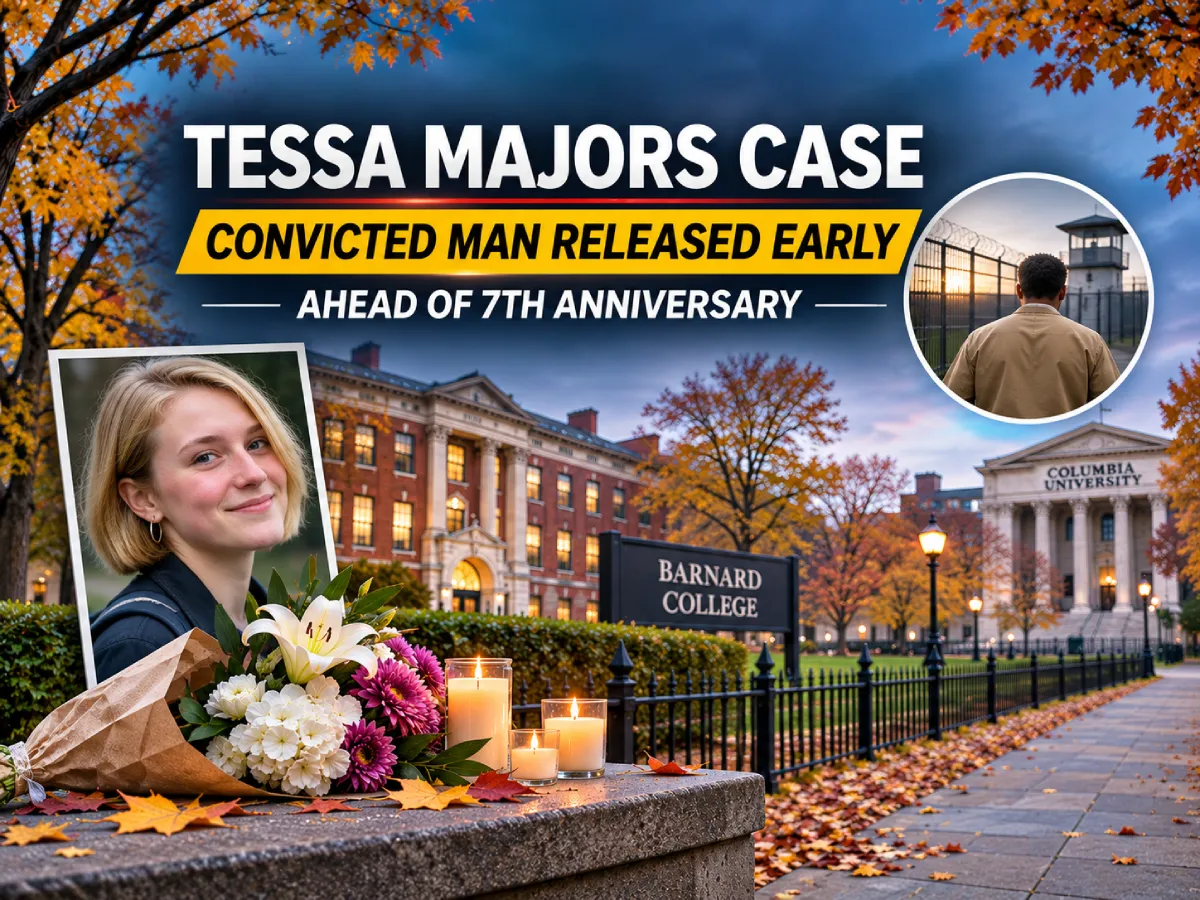

NEW YORK, November 23, 2026 — Luchiano Lewis, one of three teenagers convicted in connection with the 2019 murder of Barnard College freshman Tessa Majors, has been released from prison under supervision, nearly seven years after the killing that devastated her family and shocked New York City.
Lewis, now 21, left Franklin Correctional Facility in upstate New York on October 14, 2026, according to state correctional records cited by multiple news organizations. He was 14 when Majors, an 18-year-old first-year college student, was fatally stabbed during a robbery in Manhattan’s Morningside Park.
His release comes less than two months before December 11, the seventh anniversary of Majors’ death.
The Tessa Majors murder case has returned to public attention because Lewis received a nine-years-to-life sentence in 2021 but is now living outside prison under supervision.
For readers following major U.S. news and criminal justice developments at DealInNow, the case raises questions about sentencing young offenders, release procedures, and the continuing impact of violent crime on victims’ families.
TL;DR
Luchiano Lewis, 21, was released from a New York prison on October 14, 2026, after being convicted of murder and robbery in the 2019 killing of Barnard student Tessa Majors. Lewis, who was 14 during the attack, received a nine-years-to-life sentence in 2021. His release under supervision precedes the seventh anniversary of Majors’ death.
Key Takeaways
- Lewis was released from Franklin Correctional Facility on October 14, 2026.
- He pleaded guilty in September 2021 to second-degree murder and first-degree robbery.
- Majors, an 18-year-old Barnard freshman, was killed in Morningside Park on December 11, 2019.
- Lewis received a nine-years-to-life prison sentence but is now under community supervision.
- The case involved three teenage offenders who faced different legal proceedings and sentences.
Why Luchiano Lewis Was Released Before Completing Nine Years in Prison
Lewis’ release became public news in November 2026 after journalists reviewed records maintained by the New York State Department of Corrections and Community Supervision.
Those records showed that he had left Franklin Correctional Facility on October 14 and was placed under supervision.
The development attracted attention because Manhattan Supreme Court Justice Robert Mandelbaum had sentenced Lewis to nine years to life on October 14, 2021.
Lewis was 16 at sentencing and had been in custody following his arrest in the 2019 killing.
The difference between the sentence imposed and the time Lewis ultimately spent in custody has prompted questions about how release decisions are calculated.
What Does Release Under Supervision Mean?
New York distinguishes between discretionary parole and other forms of release from prison that may involve statutory eligibility rules and sentence credits.
Under discretionary parole, the Board of Parole assesses whether an eligible person should be released.
Other release arrangements may involve different eligibility requirements. People released into community supervision must comply with applicable conditions, and violations can have serious consequences.
News reports have described Lewis’ status as conditional release or parole supervision. However, the publicly available accounts do not establish every detail of the legal calculation used in his individual case.
The important distinction is that leaving prison under supervision does not erase a conviction or establish that the original offense has been forgiven.
Lewis remains accountable to the conditions imposed by correctional authorities.
What Happened to Tessa Majors in December 2019?
Tessa Majors was an 18-year-old student from Virginia who had recently begun her first semester at Barnard College, the women’s college affiliated with Columbia University.
On December 11, 2019, she was walking through Morningside Park in Upper Manhattan when three teenagers approached her near a staircase.
According to prosecutors, the group intended to rob her.
During the confrontation, Majors was attacked and stabbed repeatedly.
Despite her injuries, she managed to reach the street near the park before collapsing. She later died from her wounds.
Her killing generated widespread grief at Barnard and Columbia, while also renewing concerns about public safety near the campuses.
Students gathered for vigils, and flowers and other tributes appeared in her memory.
The case received national attention not only because of the circumstances of her death but also because the people involved were so young.
How the Tessa Majors Murder Case Led to Lewis’ Conviction
Lewis was among three teenagers accused of involvement in the robbery that ended in Majors’ death.
On September 21, 2021, he pleaded guilty to second-degree murder and first-degree robbery.
Although Lewis was only 14 at the time of the attack, he was prosecuted as an adult.
During his plea hearing, he acknowledged participating in the robbery but said he had not personally stabbed Majors.
He also told the court that he did not learn she had died until he encountered news coverage of the killing the following day.
His account did not remove his criminal responsibility under the charges to which he pleaded guilty.
On October 14, 2021, Judge Mandelbaum imposed a sentence of nine years to life.
The judge emphasized the gravity of the crime and the lasting harm caused by Majors’ death.
The sentencing proceedings also included statements about the profound emotional impact on her family.
What Happened to the Other Teenagers Involved?
Three teenagers were prosecuted in connection with the incident, but their cases followed different paths.
| Person | Case outcome |
|---|---|
| Luchiano Lewis | Pleaded guilty to second-degree murder and first-degree robbery; sentenced to nine years to life; released under supervision in October 2026 |
| Rashaun Weaver | Pleaded guilty to murder and robbery charges; received 14 years to life |
| Zyairr Davis | Pleaded guilty to first-degree robbery in juvenile proceedings; later faced separate criminal charges |
Weaver received the longest sentence among the three for the Majors case.
Davis, who was younger at the time of the attack, was handled through the juvenile justice system rather than being prosecuted in the same manner as Lewis and Weaver.
His subsequent legal problems involve separate incidents and should not be confused with the original Majors prosecution.
Tessa Majors’ Family and the Life She Was Building
The legal developments have renewed attention on a life that ended shortly after it had begun to take shape in New York City.
Majors was more than the victim in a widely reported criminal case.
She was a musician, writer, and promising student who had moved from Virginia to attend Barnard.
Her interests included songwriting and performing music. She had already begun participating in New York’s creative community during her first semester.
Following her death, Barnard and Columbia students came together to honor her.
The Columbia University community’s public remembrance described a young artist whose talent and energy had left an impression on people around her.
At Lewis’ sentencing, Majors’ family described the lasting devastation caused by losing their daughter.
No new statement from her immediate family concerning his October 2026 release was independently confirmed for this report.
Their earlier statements, however, made clear how deeply her death affected those closest to her.
Why the Case Continues to Raise Questions About Juvenile Sentencing
Lewis’ release also brings renewed attention to how criminal courts handle serious offenses committed by young teenagers.
New York law allows certain adolescents accused of particularly serious crimes to be prosecuted in adult court.
Sentencing courts must consider the applicable statutory framework, including the offender’s age and the severity of the offense.
Supporters of rehabilitation-focused juvenile justice policies argue that young people are still developing and may be capable of substantial change.
Others emphasize the seriousness of violent offenses, the need for accountability, and the rights of victims and their families.
These concerns can be difficult to reconcile when an offense has caused an irreversible loss.
In Lewis’ case, the public record establishes his guilty plea, sentence, and subsequent release. It does not establish whether he has been rehabilitated or how he will adjust to life under supervision.
Seven Years Later, Tessa Majors’ Death Still Resonates
December 11, 2026, will mark seven years since Majors was killed near her college campus.
Lewis’ release is a significant development in the criminal proceedings connected to that night, but it is not the end of the case’s consequences.
The convictions remain part of the legal record. Other offenders have faced their own sentences and proceedings, and Majors’ family continues to live with a loss that cannot be reversed.
The renewed attention comes at a particularly painful time, as the anniversary approaches.
For the Barnard community, the central legacy of the case remains the memory of a student whose education, music, friendships, and plans for the future were cut short in December 2019.
Disclaimer: This article is provided for general news and educational purposes. It is not legal advice. Release classifications, supervision conditions, and individual correctional records may be updated. Information about criminal proceedings has been attributed to established reporting and official sources where available.