


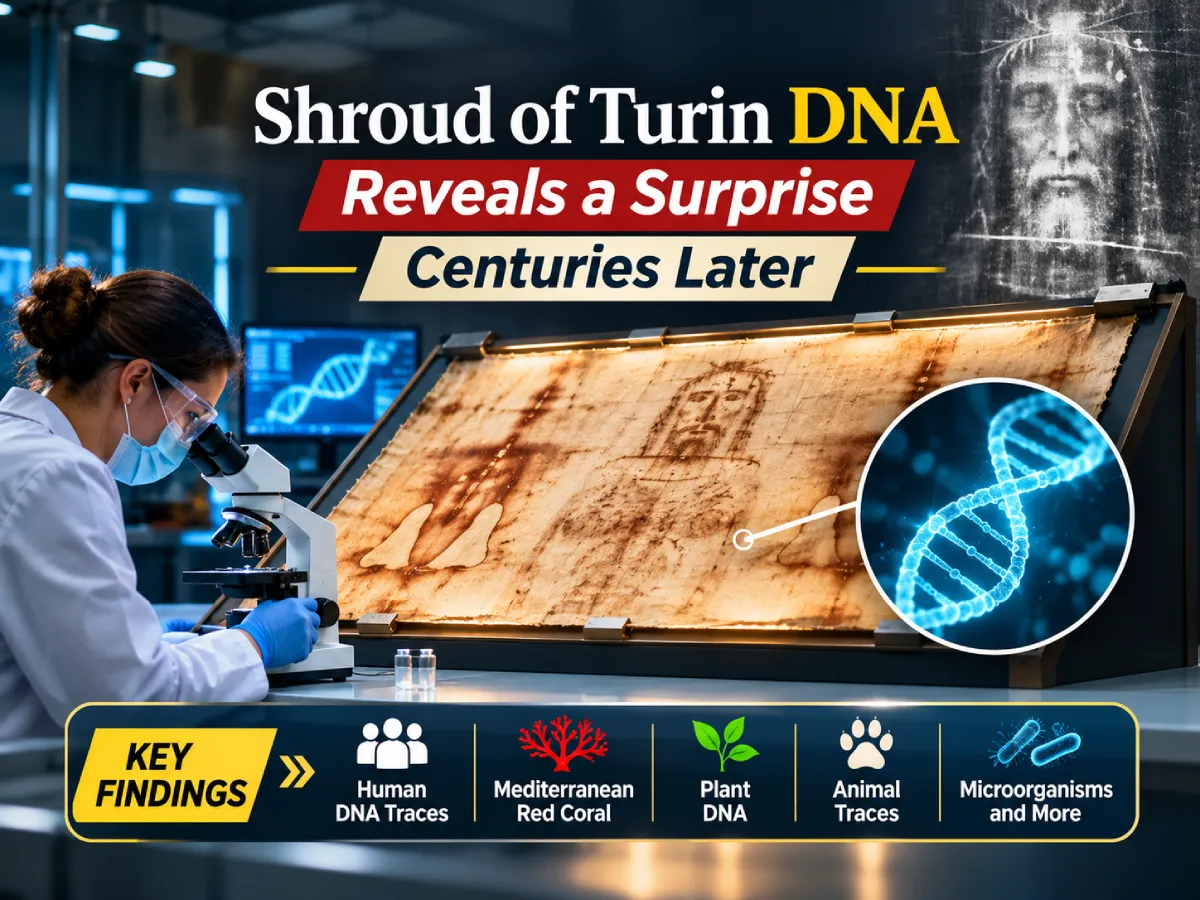

A new Shroud of Turin DNA study has uncovered an unexpected collection of biological traces on one of Christianity’s most debated relics. Among the discoveries are genetic material linked to a researcher who handled the cloth decades ago, DNA associated with Mediterranean red coral, and evidence of contact with numerous plants, animals, and microorganisms.
Published in Scientific Reports on July 9, 2026, and highlighted again in November, the research offers a closer look at the cloth’s complicated history. Scientists examined material collected in 1978 using modern genetic sequencing techniques unavailable when the samples were originally obtained.
The findings are fascinating, but they do not establish whether the Shroud was used to wrap the body of Jesus Christ.
For readers following scientific discoveries and historical mysteries at DealInNow, the biggest revelation may be how centuries of human contact have made the Shroud’s original biological evidence extraordinarily difficult to distinguish.
TL;DR
Scientists analyzing decades-old samples from the Shroud of Turin discovered human DNA linked to a 1978 researcher, along with traces of Mediterranean coral, plants, animals, and microorganisms. The findings reveal extensive environmental contamination and human handling, but they do not identify Jesus’ DNA, establish the cloth’s birthplace, or resolve its disputed age.
Key Takeaways
- Researchers analyzed material collected from the Shroud of Turin in 1978 using advanced DNA sequencing technology.
- The dominant identifiable human genetic signature matched the scientist who collected the original samples.
- DNA associated with red coral, carrots, wheat, maize, bananas, and domesticated animals was detected.
- Some genetic traces suggest contamination accumulated during comparatively recent centuries.
- The findings do not overturn the 1988 radiocarbon analysis that dated the tested linen to AD 1260–1390.
Shroud of Turin DNA Reveals a Surprising Connection to a 1978 Researcher
One of the study’s most striking discoveries involved human DNA.
Researchers identified several mitochondrial DNA lineages, which are genetic patterns passed through the maternal line. Some were associated with populations from Europe and the Near East.
However, the strongest identifiable human genetic signature was linked to Pierluigi Baima Bollone, the Italian forensic physician who collected the samples in 1978.
Investigators compared the genetic material recovered from the Shroud samples with the collector’s own DNA. Their analysis supported a close genetic connection, consistent with the same individual or a first-degree relative.
That finding demonstrates a central difficulty in studying historical artifacts: even scientists who examine an object can unintentionally leave biological evidence behind.
The research therefore provides an important reminder that finding human DNA on an ancient object does not necessarily identify someone connected to its original use.
Why the DNA Cannot Identify the Person Depicted on the Cloth
The Shroud bears a faint image resembling the front and back of a man who appears to have suffered injuries associated with crucifixion.
Many Christians have traditionally believed the linen was used to wrap Jesus after his death.
Yet researchers cannot determine which human genetic traces, if any, were deposited when the image first appeared.
The material has been handled, displayed, repaired, and examined across many generations. Genetic evidence from those interactions can accumulate on the textile.
Consequently, the DNA findings cannot establish the identity of the man represented by the image.
The Red Coral Discovery Adds an Unexpected Mediterranean Clue
Human DNA was only one part of the story.
Scientists also detected genetic material associated with Corallium rubrum, commonly known as Mediterranean red coral.
This species is native to the Mediterranean Sea and has historically been used in jewelry, ornaments, and religious objects.
Its presence raises questions about the different environments and materials that may have come into contact with the Shroud.
However, discovering coral DNA does not prove the cloth traveled through a particular coastal region.
Coral particles might have reached the textile indirectly through objects, handling, or environmental exposure.
The researchers identified other biological traces consistent with Mediterranean connections, but individual findings cannot reconstruct the Shroud’s complete historical journey.
From Carrots to Cats: The Unexpected Genetic Inventory
The analysis revealed an unusually diverse collection of organisms.
Researchers reported traces associated with cultivated crops, domestic animals, bacteria, fungi, and salt-tolerant microorganisms.
| DNA or biological evidence | What researchers found |
|---|---|
| Human DNA | Multiple genetic lineages, including the 1978 sample collector |
| Mediterranean coral | Genetic material associated with red coral |
| Cultivated plants | Carrots, wheat, maize, bananas, and peanuts |
| Domestic animals | Cattle, pigs, chickens, dogs, and cats |
| Microorganisms | Skin-associated bacteria, fungi, and salt-tolerant archaea |
Several of these findings are especially revealing because the plants involved became widely available in Europe at different points in history.
Maize and peanuts, for example, originated in the Americas and reached Europe through trade and agricultural exchange after transatlantic contact.
Their genetic traces cannot reasonably be treated as evidence that every organism was present when the cloth was first made.
Instead, the mixture points toward biological material accumulating over a long period.
The researchers also reported that some carrot DNA resembled cultivated varieties developed in Europe during the late medieval and early modern periods.
Such findings reinforce the importance of separating later contamination from possible evidence of an artifact’s earliest history.
Could the Shroud of Turin Have Origins in India?
An earlier genetic investigation published in 2015 identified human mitochondrial DNA patterns associated with several geographic regions, including the Indian subcontinent.
Those findings prompted researchers to consider whether some of the linen or yarn might have originated in India and reached the Mediterranean through historical trade networks.
The 2026 study revisited that possibility.
However, the newer sequencing analysis could not confidently reconstruct the particular South Asian mitochondrial lineages discussed in the earlier work.
That distinction matters.
Genetic material associated with a population does not establish where a textile was manufactured. DNA can be transferred through direct contact, transported materials, airborne particles, and later conservation procedures.
Outside experts have also questioned whether every plant and animal identification can be treated with equal confidence, given the limitations of matching degraded genetic fragments to reference databases.
An Indian connection remains a research hypothesis, not a proven answer to the Shroud’s geographical origins.
What the 2026 Study Says About the Shroud’s Age
The new genetic research does not replace radiocarbon dating.
In 1988, laboratories at Oxford, Zurich, and the University of Arizona tested a sample of the Shroud. Their findings, published in Nature in 1989, placed the tested fabric between AD 1260 and 1390 with at least 95% confidence.
That result aligned with the Shroud’s earliest firmly documented appearances in medieval France.
Some researchers have challenged whether the tested sample adequately represented the entire cloth, and the dating debate continues.
The 2026 investigators also radiocarbon-dated two loose linen threads collected from the reliquary in which the Shroud had been stored.
Those threads produced date ranges of AD 1451–1622 and AD 1642–1800.
The researchers noted that these periods overlap with historical repairs and conservation work.
Importantly, those results concern threads from the reliquary and should not be presented as a new date for the original Shroud.
Neither the genetic findings nor those additional thread measurements establish that the cloth dates to the first century.
Why Scientists Still Cannot Solve the Shroud’s Biggest Mystery
The Shroud’s history illustrates the difficulty of studying an artifact with enormous religious significance and centuries of human interaction.
Its genetic record contains material from different sources and potentially different historical periods.
Modern sequencing can identify biological traces that older technologies might have missed. But genetic identification is not the same as establishing when material arrived, how it was transferred, or whether it was present when the textile was created.
The University of Padua researchers acknowledged that their findings must be interpreted alongside historical records, forensic investigations, and radiometric evidence.
Further work could improve understanding of how the cloth was stored, handled, and exposed to biological material.
Yet scientists would still need stronger evidence to determine its original manufacture, age, and connection to any particular historical person.
A New Scientific Chapter, Not a Final Verdict
Nearly five decades after the original samples were collected, modern DNA sequencing has revealed details that earlier investigators could not examine with the same precision.
The discovery of the collector’s genetic signature is especially instructive. It shows how modern contact can become part of what researchers later interpret as an artifact’s biological history.
The red coral, crop DNA, animal traces, and diverse microorganisms add further evidence of a complicated environmental record.
For believers, the Shroud remains an object of spiritual significance. For historians and scientists, its documented medieval history and unresolved questions continue to warrant investigation.
The 2026 research does not settle the question of authenticity. Instead, it explains why obtaining a definitive genetic answer may be considerably more difficult than it first appears.
Disclaimer: This article is provided for educational, historical, and scientific news purposes. Religious beliefs are discussed respectfully and distinguished from experimentally established findings. Genetic evidence described here should not be interpreted as proof of the Shroud’s authenticity or of any biblical event.
Verified External Sources
Original peer-reviewed study Scientific Reports — DNA signatures preserved in Shroud samples
University of Padua research announcement University statement — July 10, 2026
Independent scientific assessment Scientific American — Why DNA cannot establish the Shroud’s origin
Original radiocarbon research Nature — Radiocarbon dating of the Shroud of Turin (1989)
November research coverage ScienceDaily — November 8, 2026 summary