


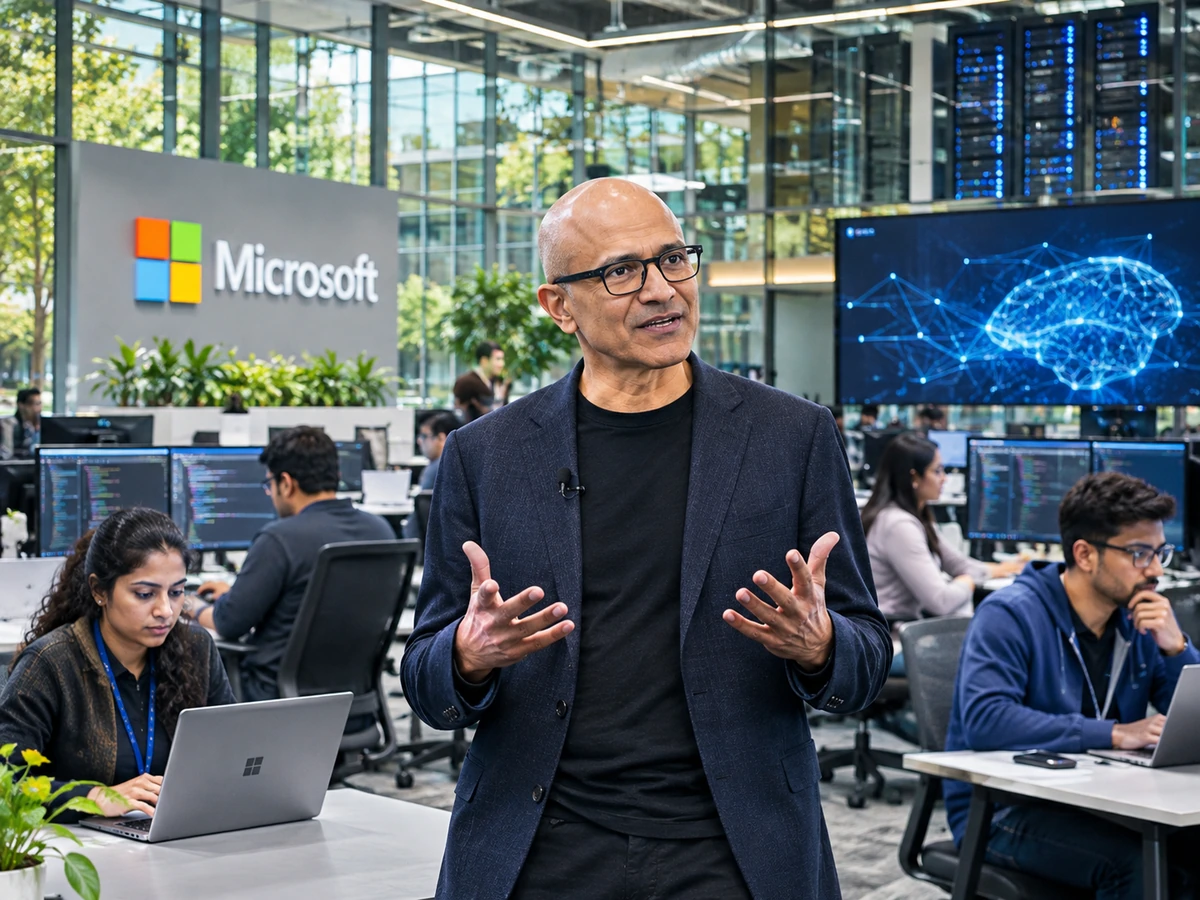

Microsoft buyout offers affecting approximately 60,000 eligible employees have placed CEO Satya Nadella at the center of a growing debate about artificial intelligence and the future of work. The technology executive says the voluntary exit program is intended to give employees greater control over their careers as Microsoft reorganizes around AI-powered tools.
Speaking at The New York Times DealBook Summit on November 18, 2026, Nadella defended the company’s approach while rejecting the idea that artificial intelligence has made software engineers unnecessary.
Instead, he believes software development is entering a new phase in which engineers increasingly direct AI systems rather than personally performing every step of the programming process.
For readers following technology and employment developments at DealInNow, the announcement raises an important question: Can a company transform its workforce around AI while continuing to create meaningful opportunities for its employees?
TL;DR
Microsoft offered voluntary exit packages to approximately 60,000 eligible workers across four countries in October 2026. CEO Satya Nadella says the program gives employees greater control as AI transforms workplace responsibilities. He maintains software engineering will remain important, although employees may increasingly supervise AI agents instead of completing every task manually.
Key Takeaways
- Microsoft introduced its Voluntary Exit Offer on October 26, 2026.
- Approximately 60,000 employees are eligible, but that does not mean they will all leave.
- The program covers participating teams in the United States, Canada, the United Kingdom, and India.
- Nadella says software engineering remains a valuable career despite AI automation.
- Microsoft has not disclosed how many employees will ultimately accept the offer.
Why Microsoft Offered Voluntary Exit Packages to 60,000 Employees
Microsoft’s workforce initiative represents a substantial organizational change at one of the world’s largest technology companies.
On October 26, Chief People Officer Amy Coleman introduced the company’s new Voluntary Exit Offer, or VEO, through an official employee communication.
The program allows qualifying workers to leave Microsoft with financial support and career-transition resources.
Unlike a traditional layoff, participation is voluntary.
However, the offer is not available across every department or to every employee.
According to Microsoft’s official announcement, eligibility depends on business priorities, employee job level, and whether the relevant organization participates.
The program applies to employees at internal level 70 and below in selected teams across four countries.
Approximately 60,000 workers qualify, according to reporting from The Wall Street Journal and other outlets.
Is Microsoft Actually Laying Off 60,000 Workers?
No. The number describes employees eligible to consider an exit offer, not confirmed job losses.
Microsoft has not announced how many people will accept.
The company also distinguishes this initiative from its earlier Voluntary Retirement Program.
Some reports describe the new arrangement as a buyout, although a Microsoft spokesperson characterized its financial terms as closer to a standard severance offer than an enhanced retirement incentive.
The difference matters for employees trying to understand what they would actually receive.
Individual eligibility and financial arrangements must be confirmed through Microsoft’s official employee communications.
Nadella Says the Decision Was About Giving Employees a Choice
Nadella addressed the controversy during his November 18 conversation with journalist Andrew Ross Sorkin at the DealBook Summit.
He explained that Microsoft faces a difficult transition as AI changes how employees work.
The company cannot simply introduce new technology and assume that its existing organizational structures will continue operating in exactly the same way.
For some employees, that transformation may create attractive opportunities. Others may prefer a different career direction.
Nadella said the voluntary exit program was intended to ensure employees felt they had “agency in making choices.”
His comments reflect an acknowledgment that organizational change can be unsettling, even when management believes the transition is necessary.
However, the availability of an exit package does not resolve every concern about job stability.
Workers must still evaluate their financial security, future employment prospects, and whether remaining at Microsoft offers a realistic path forward.
The question is especially significant because the company’s restructuring comes during a period of widespread debate about whether AI will reduce demand for certain white-collar jobs.
Microsoft Buyout Offers Come as AI Changes Software Engineering
One of Nadella’s most notable statements concerned the future of programming.
The Microsoft CEO described how expectations around AI-generated software have changed dramatically.
Initially, some engineers doubted that artificial intelligence could perform meaningful programming work.
As coding tools improved, speculation shifted toward whether software developers would eventually be needed at all.
Nadella now argues that this view is too simplistic.
He said software engineering is “very much alive” and expects the profession to continue developing.
The difference, in his view, lies in what engineers will actually do.
Why AI Could Change a Developer’s Daily Responsibilities
Traditionally, software engineers have spent considerable time writing, testing, reviewing, and maintaining code.
AI-powered development tools can now assist with many of those activities.
That could allow developers to focus more attention on system architecture, technical decisions, security, testing strategies, and supervising automated workflows.
But AI-generated code still requires careful verification.
Software failures can create security vulnerabilities, disrupt customer services, or lead to costly operational problems.
Human engineers remain responsible for understanding whether the systems they build perform correctly and safely.
Nadella’s argument is not that every programming task will disappear.
It is that engineering teams may become more productive while operating with different responsibilities and structures.
The 11-Developer Example Behind Nadella’s AI Strategy
To explain how Microsoft is changing, Nadella pointed to the team developing Cowork, an AI agent capability within the Microsoft 365 ecosystem.
He said the team consists of approximately 11 developers.
Rather than manually producing every component of the software, the team uses AI-supported workflows to help build and maintain the product.
Nadella described this approach as creating a software factory capable of producing software.
The example illustrates his vision of smaller teams directing AI systems to handle larger portions of development work.
However, the 11-person team is an example provided by Nadella, not evidence that all software projects can operate effectively with the same number of engineers.
Different applications require different levels of complexity, oversight, security, and ongoing maintenance.
Microsoft’s broader argument is that employees may increasingly become supervisors of AI-powered processes rather than performing every task directly.
How Large Is Microsoft’s Workforce?
Microsoft reported approximately 223,000 full-time employees worldwide as of June 30, 2026.
That means the voluntary exit program potentially reaches more than one-quarter of its global workforce.
The company also reported strong business performance for fiscal 2026.
| Microsoft workforce and business metric | Reported figure |
|---|---|
| Worldwide employees | Approximately 223,000 |
| U.S. employees | Approximately 121,000 |
| International employees | Approximately 102,000 |
| Employees eligible for exit offers | Approximately 60,000 |
| Fiscal 2026 revenue | $331.8 billion |
| Microsoft Cloud revenue | $214.4 billion |
Workforce and revenue figures are from Microsoft’s fiscal 2026 annual report. The eligible employee figure comes from October 2026 reporting.
Microsoft’s financial strength makes the restructuring particularly significant.
This is not a company publicly describing an emergency financial collapse.
Instead, Microsoft is attempting to change how its workforce operates while investing heavily in cloud infrastructure, AI products, and automation.
That distinction does not make the transition painless for employees.
It illustrates how technological changes can reshape staffing decisions even at highly profitable companies.
What the Buyout Decision Means for U.S. Tech Workers
For software developers and other technology professionals, Microsoft’s announcement highlights how quickly employer expectations are changing.
Technical expertise remains important, but familiarity with AI-assisted tools is becoming increasingly relevant.
Workers may benefit from developing skills that combine software development with system design, AI evaluation, cybersecurity, and practical problem-solving.
Still, employees considering a voluntary exit should not assume that an attractive package automatically outweighs the benefits of staying employed.
Health insurance, stock compensation, retirement benefits, tax consequences, and the availability of comparable jobs can significantly affect the decision.
Microsoft’s program is time-limited, with employees generally expected to make decisions by early December. Exact deadlines may differ by location and individual offer.
Eligible workers should review their official documents carefully before accepting.
The company has not confirmed that participation protects employees from all future organizational changes, nor has it established how many jobs will ultimately disappear.
Can Microsoft Balance AI Productivity With Employee Confidence?
Nadella’s remarks reveal a central tension in the AI economy.
Technology companies want to increase productivity through automation while maintaining the expertise necessary to build reliable products.
Employees, meanwhile, want to know whether improving AI capabilities will strengthen their careers or gradually reduce their opportunities.
Microsoft’s voluntary exit program gives some workers a choice about whether to remain through the transition.
But the company’s longer-term challenge extends beyond offering financial packages.
It must demonstrate that its AI-first strategy can create sustainable business value while retaining the skills, experience, and trust needed to operate effectively.
Nadella believes software engineering will continue to thrive.
The coming years will test whether Microsoft’s evolving workplace can deliver on that promise—and what the change ultimately means for the people building its products.
Disclaimer: This article is provided for general technology, business, and employment news purposes. It does not constitute legal, financial, investment, or career advice. Voluntary exit packages, benefits, eligibility requirements, and deadlines may vary by employee and jurisdiction. Workers should review official company documentation and seek qualified professional advice before making employment decisions.
Verified External Sources
These sources support the article’s major claims.
Microsoft — Official voluntary exit announcement Introducing a Voluntary Exit Offer
TechCrunch — Nadella’s DealBook remarks Microsoft CEO explains voluntary exits and AI changes
Microsoft — Fiscal 2026 annual report Microsoft Annual Report 2026