


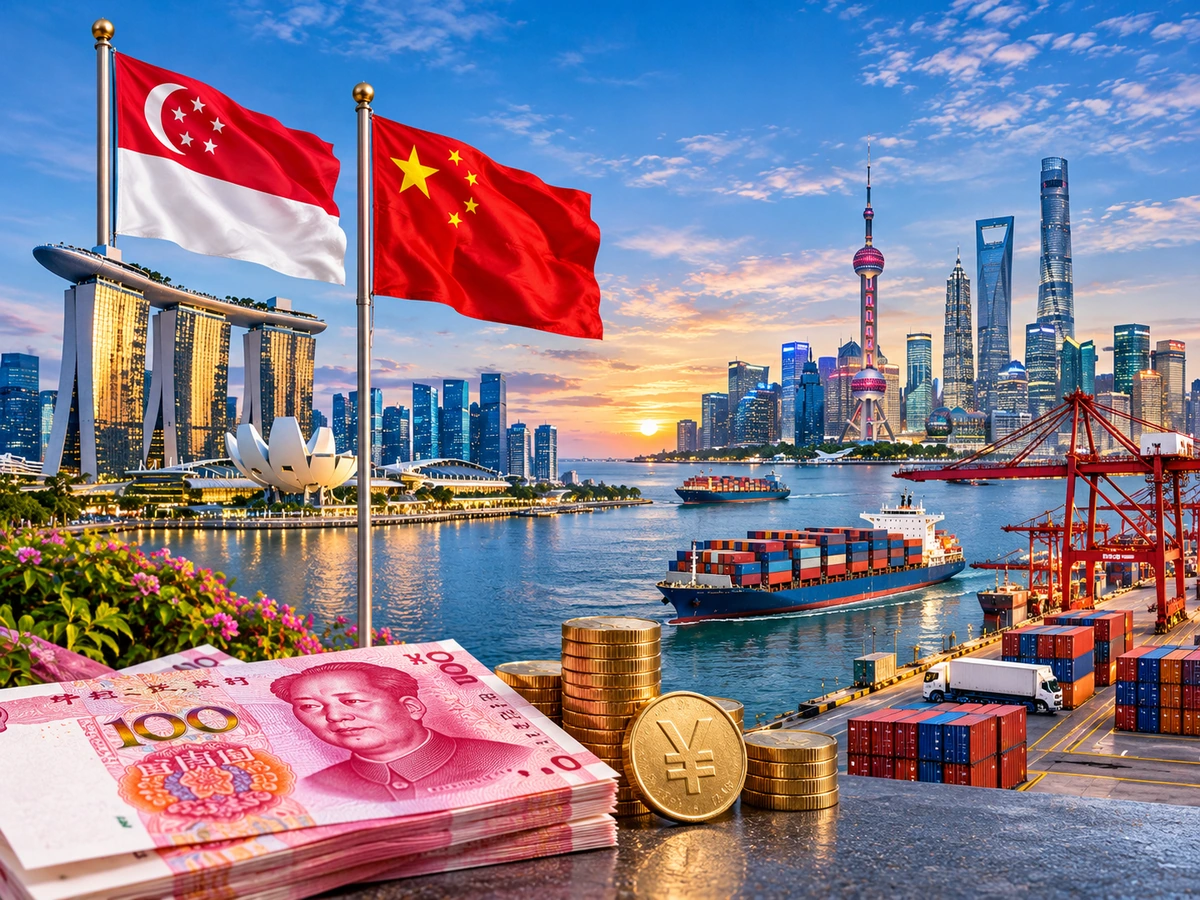

SINGAPORE, November 24, 2026 — Singapore and China are strengthening their financial relationship by expanding access to Chinese yuan funding for businesses, a move designed to make cross-border trade, corporate investment, and regional financing easier.
The latest Singapore-China yuan financing initiative was announced November 23 by the Monetary Authority of Singapore (MAS) following high-level bilateral meetings with Chinese officials. The plan will give eligible financial institutions more flexibility to obtain renminbi funding for corporate customers.
The agreement comes as Singapore’s offshore yuan market continues to expand. Yuan deposits in the city-state reached a record 337 billion yuan, approximately $50.6 billion, at the end of the first half of 2026, according to MAS data compiled by Bloomberg.
For readers following global finance and economic developments at DealInNow, the announcement highlights China’s efforts to encourage wider international use of its currency while reinforcing Singapore’s role as a financial gateway to Southeast Asia.
TL;DR
Singapore and China have agreed to expand yuan financing for businesses by restructuring an existing central bank facility into separate corporate and liquidity programs. The measures will support trade finance, working capital, and investment spending. Both countries are also exploring faster cross-border payments and closer capital-market cooperation, although several initiatives remain under development.
Key Takeaways
- Singapore and China announced new renminbi financing measures on November 23, 2026.
- The existing facility will be divided into an RMB Corporate Facility and an RMB Liquidity Facility.
- Eligible financial institutions can access yuan funding for third-country trade, working capital, and capital expenditures.
- Singapore’s yuan deposits reached a record 337 billion yuan during the first half of 2026.
- Authorities are exploring cross-border instant payments, expanded collateral options, and additional investment products.
How Singapore-China Yuan Financing Will Work
The central feature of the agreement is an overhaul of the existing MAS Renminbi Facility.
Rather than treating all yuan funding needs through a single arrangement, the two central banks will establish separate facilities designed for different purposes.
The RMB Corporate Facility will support business-related financing, while the RMB Liquidity Facility will continue providing backup funding to eligible financial institutions.
The corporate program is intended to accommodate a broader range of commercial activities, including trade with countries beyond Singapore and China.
What the New Corporate Facility Will Cover
Under the November 23 announcement, eligible banks and other qualifying financial institutions will be able to access yuan funding for several purposes:
- Trade financing involving third countries.
- Working capital needed for daily business operations.
- Capital expenditures, including business investment.
- Eligible funding transactions between companies within the same corporate group.
The expanded facility will also offer financing periods of one, three, and six months.
This flexibility could be particularly useful for companies managing international supply chains, purchasing inventory, or financing expansion projects.
For example, a business operating through Singapore that purchases goods from Chinese suppliers could potentially benefit from greater access to yuan-denominated financing through participating banks.
The arrangement does not mean businesses can borrow directly from the central banks. Commercial financial institutions remain the channel through which eligible corporate customers would obtain financing.
A $50 Billion Currency Swap Supports the Agreement
The funding arrangements are backed by an established bilateral currency swap agreement between MAS and the People’s Bank of China (PBOC).
The agreement, renewed in July 2022 for five years, provides access to as much as 300 billion yuan in Chinese currency liquidity and S$65 billion in Singapore-dollar liquidity.
The yuan portion is worth roughly $45 billion to $50 billion, depending on exchange rates.
This arrangement allows the central banks to exchange currencies and supply funding to eligible financial institutions when required.
Importantly, the swap limit is not an announcement of new loans already made to companies.
It represents a framework through which currency liquidity can be accessed, subject to the relevant arrangements and eligibility requirements.
Singapore Government Securities Can Be Used as Collateral
Authorities are also widening the assets financial institutions can pledge when accessing yuan liquidity.
Previously, the facility accepted Singapore-dollar cash as collateral.
The enhanced arrangements will additionally accept Singapore Government Securities and MAS Bills.
Singapore and China are examining whether Chinese government bonds should also become eligible.
Accepting more forms of collateral could make it easier for financial institutions holding government securities to obtain yuan funding without first converting those assets into cash.
However, the proposal involving Chinese government bonds has not yet been finalized.
Why Singapore Is Becoming an Important Yuan Financing Hub
Singapore has spent years positioning itself as a major offshore center for renminbi transactions.
Its role as a financial and trading hub makes it an important connection between China, Southeast Asia, and international investors.
The growing volume of yuan deposits reflects increasing activity in currency settlement, trade, and investment.
According to Bloomberg’s November 24 reporting, Singapore’s yuan deposits reached 337 billion yuan by the end of June 2026, equivalent to approximately $50.6 billion at the exchange-rate comparison used in the report.
The latest measures build on earlier developments.
In December 2025, DBS Bank was appointed Singapore’s second renminbi clearing bank, joining the Industrial and Commercial Bank of China’s Singapore branch.
MAS confirmed on November 23 that DBS had begun providing yuan clearing services.
These services help financial institutions process payments and settle transactions in Chinese currency.
Expanding clearing access and financing options could strengthen Singapore’s ability to serve companies conducting business throughout Asia.
China and Singapore Also Plan Faster Cross-Border Payments
The agreement extends beyond corporate loans.
MAS and the PBOC are exploring a connection between their fast-payment systems to support smaller-value cross-border transfers.
Such a link could eventually make certain payments between the two economies more convenient.
However, officials have not announced that the connection is operational, nor have they confirmed a launch date.
The countries are also expanding cooperation involving financial markets.
MAS and the China Securities Regulatory Commission plan to support companies seeking listings and fundraising opportunities across both markets.
Singapore Exchange cooperation with the Shanghai and Shenzhen stock exchanges could lead to additional exchange-traded fund products and market indexes.
Bank of China’s Singapore branch has also been included as an MAS Primary Dealer, expanding its participation in Singapore’s government securities market.
Separately, Singapore Exchange and the China Foreign Exchange Trade System intend to cooperate on Panda Bond listings in Singapore.
Together, these measures could create more channels for companies and investors seeking access to Chinese and Singaporean financial markets.
What the Yuan Agreement Means for U.S. Businesses
Although the measures directly involve Singapore and China, their consequences may extend to American companies operating in Asia.
U.S. manufacturers, retailers, logistics providers, and multinational corporations frequently maintain regional operations and supplier relationships across Southeast Asia and China.
Greater availability of yuan-denominated funding could provide an additional financing option for some cross-border transactions.
Companies with substantial yuan expenses may also find it useful to match their financing currency with their expected cash flows.
However, borrowing in yuan introduces exchange-rate exposure when a company’s revenue is primarily denominated in U.S. dollars.
A movement in the dollar-yuan exchange rate can change the effective cost of repaying a loan.
The initiative does not automatically replace dollar financing or demonstrate that companies are abandoning the U.S. currency.
Instead, it adds financial infrastructure that may make yuan transactions more practical for businesses with the appropriate needs.
China’s Wider Effort to Expand International Yuan Use
China has been pursuing greater international use of the renminbi through trade settlement, banking agreements, and offshore financial centers.
Promoting yuan financing outside mainland China can reduce certain currency-conversion requirements for companies trading with Chinese partners.
Singapore’s latest agreement fits into that broader strategy.
The November 23 meeting also produced numerous other cooperation outcomes, including plans to upgrade the China-Singapore Free Trade Agreement and expand collaboration in digital trade.
But several questions remain unanswered.
Authorities have not detailed the full implementation timeline for the enhanced yuan facilities, the eventual scale of corporate borrowing, or the precise commercial terms that participating banks will offer customers.
Those details will determine how significantly the measures affect financing decisions.
What Comes Next for Singapore-China Financial Cooperation?
The agreement is an important development for Singapore’s offshore yuan market, but its practical impact will emerge gradually.
Financial institutions must incorporate the enhanced arrangements into their operations, while businesses will assess whether yuan financing offers advantages over existing alternatives.
Further announcements could clarify the payment-system proposals, eligibility of Chinese government bonds as collateral, and the timing of additional investment products.
For Singapore, the opportunity is to strengthen its position as a regional center for corporate finance.
For China, the goal is to make its currency more useful in international commerce.
Whether the expanded facilities significantly change how businesses borrow and settle payments will depend on actual demand rather than the announcement alone.
Disclaimer: This article is for general business news and informational purposes only. It does not constitute financial, investment, lending, or foreign-exchange advice. Currency values, financing terms, regulations, and market conditions may change. Businesses should consult qualified financial professionals before making financing decisions.
Verified External Sources
Monetary Authority of Singapore — Primary announcement
Singapore and China Strengthen Financial Cooperation with New RMB Initiatives
November 23, 2026 · Official confirmation of the financing facilities, collateral changes and banking arrangements. mas.gov.sg
Singapore Prime Minister’s Office
Deputy Prime Minister Gan Kim Yong’s November 23 briefing
Explains the broader financial, trade and investment strategy. Prime Minister’s Office Singapore
Bloomberg, via The Edge Singapore
November 24 reporting on Singapore-China yuan financing
Independent reporting, the yuan deposit figure, and banking-sector context. The Edge Singapore
Channel NewsAsia
Singapore-China financial cooperation and trade agreement talks
Additional reporting on the 22nd bilateral cooperation meeting. CNA